

to the rhythm of
 2
3.2
2
3.2

- idiom
- My group swayed and clapped to the rhythm of the song.
- to the rhythm of the drums
- sway to the rhythm of
- dancing to the rhythm of
Loading YouTube…
Watch on YouTubeOr I could slash apart colored blocks to to the rhythm of the music.
- Or I could slash apart colored blocks to to the rhythm of the music.
- So by attending to the rhythm of the breath or breathing it in certain rhythms sets the clock in in its right perspective.
Examples
-
She tapped her foot to the rhythm of the upbeat song playing in the background.
-
But Noah drummed his fingers to the rhythm of the Grateful Dead.
Fiction book (1995) -
Tonight they would dance together to the rhythm of the drums.
Fiction book (1995) -
The girl danced to the rhythm of a popular song.
Fiction book (1998) -
Waves rushed in and out, crashing and sighing to the rhythm of the couple's movements.
Fiction book (1999) -
Loose seeds shake inside as they shuffle in the sandy dirt to the rhythm of the drummer.
Blog text (20) -
Happy tires make happy drivers, Phillip thought, drumming his fingers on the wheel to the rhythm of Keith Richards's outlaw guitar.
Fiction book (1998) -
The dancers moved gracefully to the rhythm of the music, perfectly synchronizing their steps.
-
As we walked, we spoke softly to each other to the rhythm of the gentle waves crashing on the shore.
Synonyms
 13
2.2
13
2.2
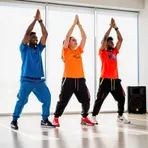
At the right beat so movement matches the music
 10
4.1
10
4.1
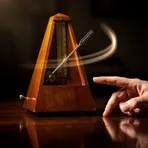
In a steady pattern of sound or movement
How Rhythmic


Surface Forms
Morphology
to + the + rhythm + of
The phrase 'to the rhythm of' is a compositional prepositional sequence: 'rhythm' denotes a regular beat or pattern and the prepositions 'to'/'of' express alignment, so the meaning 'in accordance with the beat/tempo' follows directly from the parts. This construction is cross-linguistically common (e.g. Spanish 'al ritmo de', French 'au rythme de'), making it predictable for a B1 learner who knows the constituent words.
Etymology
To the rhythm of comes from the picture of moving with a steady rhythm, like dancers or marching soldiers following a drum. That's why it means 'in time with the beat or pattern'.