

thermonuclear reaction
 1
7.7
1
7.7

- noun
- /ˌθɜrməˈnjuːklɪr riˈækʃən/
- Specialized
- Fast neutrons generated in thermonuclear reactions in the thermonuclear fuel layers would trigger fissions in the adjacent fissionable layers, significantly boosting the energy release.
Examples
-
Discussions between Fermi and Teller ultimately suggested the feasibility of using an atomic explosion to initiate thermonuclear reactions in a deuterium medium.
Academic text (1996) -
Could this just be another version of a runaway thermonuclear reaction like we see in stars?
-
The decision was made to conduct test-site explosion experiments involving thermonuclear reactions in 1951.
Academic text (1996) -
The ionization compression of the thermonuclear fuel would sharply increase the thermonuclear reaction rate.
Academic text (1996) -
This increase results from changes in the chemical composition of the star's core due to thermonuclear reactions that turn hydrogen into helium and liberate energy.
Academic text (2006) -
Astronomers believe that only hydrogen and helium were created in the Big Bang explosion that started our universe; all other elements form in thermonuclear reactions inside stars.
Academic text (1992) -
The energy produced by the thermonuclear reaction in the Sun is what keeps our planet warm and provides light.
-
Researchers are studying the conditions necessary for a thermonuclear reaction to occur in fusion reactors on Earth.
-
During a thermonuclear reaction, hydrogen nuclei combine to form helium, releasing vast amounts of energy in the process.
Synonyms
 73
5.9
73
5.9
A nuclear reaction where the cores of atoms join and release energy
 4
4.2
4
4.2
A process where two small parts inside atoms join and give off energy
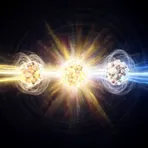
A process where two atoms combine to make a heavier atom and give off energy
How Energetic
- Specialized
1
7.7

- Specialized
4
4.9
- Specialized
24
3.1
Surface Forms
Morphology
The phrase is fully compositional: 'thermonuclear' (pertaining to nuclear processes at very high temperatures) combined with 'reaction' yields the meaning 'a nuclear reaction occurring at high temperatures.' This is a transparent technical compound with direct equivalents in other languages, so a learner who knows both constituents can derive the MWE's meaning.
Etymology
The term thermonuclear reaction comes from the idea that very high heat, shown by thermo, makes the centers of atoms, shown by nuclear, smash together and 'join' to release energy. This picture, like what happens in the sun or in a hydrogen bomb, explains why the term means a reaction where atom centers join at very high heat and give off a huge amount of energy.