
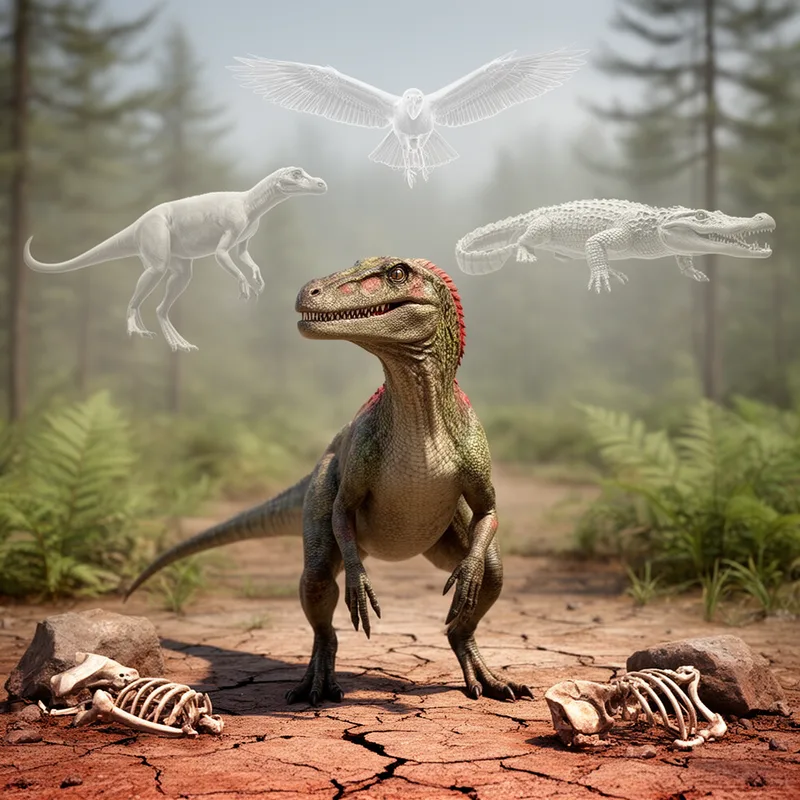
thecodont
- noun
- /ˈθiːkəˌdɒnt/
- Archaic
- Paleontologists once classified many early archosaurs as thecodonts.
Examples
-
Fossils of thecodonts show features that link them to both crocodiles and birds.
-
The thecodont fossils were discovered in South America.
-
The teeth of thecodonts were set in sockets, a trait shared with later dinosaurs.
-
Many thecodonts lived during the Triassic period.
-
The thecodont is considered an important ancestor of today’s crocodiles and birds.
-
Paleontologists study thecodonts to understand the evolution of archosaurs.
-
Fossils of thecodonts provide valuable insights into the early development of reptiles.
Synonyms

An extinct reptile thought to be an early ancestor of dinosaurs, crocodiles and birds
Extinct group of early reptiles with teeth set in sockets before dinosaurs

A group of land reptiles that died out long ago and had teeth in sockets
Compounds
- Archaic
An extinct reptile thought to be an early ancestor of dinosaurs, crocodiles and birds
Surface Forms
Morphology
thecodont = theco + dont
Formed from Greek combining forms ('theco-' + '-dont') common in scientific names; these are not standalone English words and the term is specialised, so learners cannot reliably infer the meaning from its parts.
Etymology
Thecodont comes from Greek parts theke ('case' or 'socket') and odont ('tooth'). It was used for early reptiles whose teeth were set in sockets, so the name literally means 'socket-toothed' and helps you remember the key feature that links them to later dinosaurs, crocodiles and birds.

