
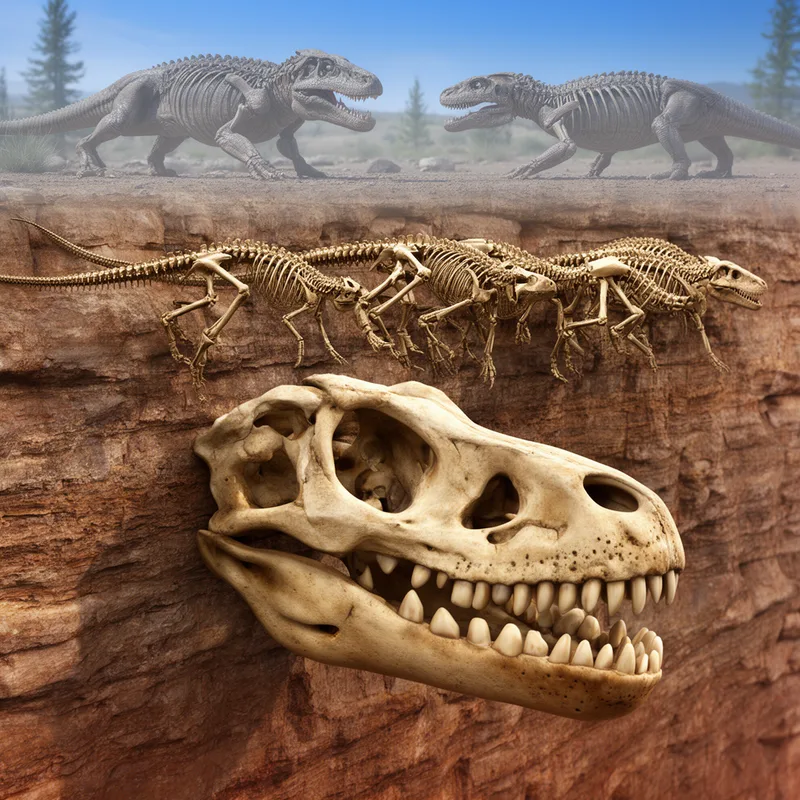
order Thecodontia
- noun
- /ˈɔrdər ˌθiːkəˈdɒntɪə/
- Archaic
- Fossils attributed to the order Thecodontia have been found across several continents.
Examples
-
Many paleontologists once classified early archosaurs within the order Thecodontia.
-
The order Thecodontia is now considered paraphyletic, but was important to our understanding of reptile evolution.
-
The order Thecodontia includes several fascinating species.
-
Many fossils belong to the order Thecodontia.
-
Fossils attributed to the order Thecodontia have been found across several continents.
-
Many paleontologists once classified early archosaurs within the order Thecodontia.
-
The order Thecodontia is now considered paraphyletic, but was important to our understanding of reptile evolution.
Synonyms
Extinct group of early reptiles with teeth set in sockets before dinosaurs

An extinct reptile thought to be an early ancestor of dinosaurs, crocodiles and birds
Surface Forms
Morphology
The phrase is compositionally built from 'order' (a taxonomic grouping) plus the taxon name 'Thecodontia', so its meaning as ‘the taxonomic order called Thecodontia’ is directly derivable from the parts. This is a standard, cross-linguistic noun + name construction in scientific classification, making it transparent to learners who know both constituents.
Etymology
Order Thecodontia comes from Greek parts: theco- meaning 'socket' and -dontia meaning 'tooth', giving the image of a tooth in a socket. That's why the name was used for a group of extinct land reptiles known for having their teeth set in sockets.

