
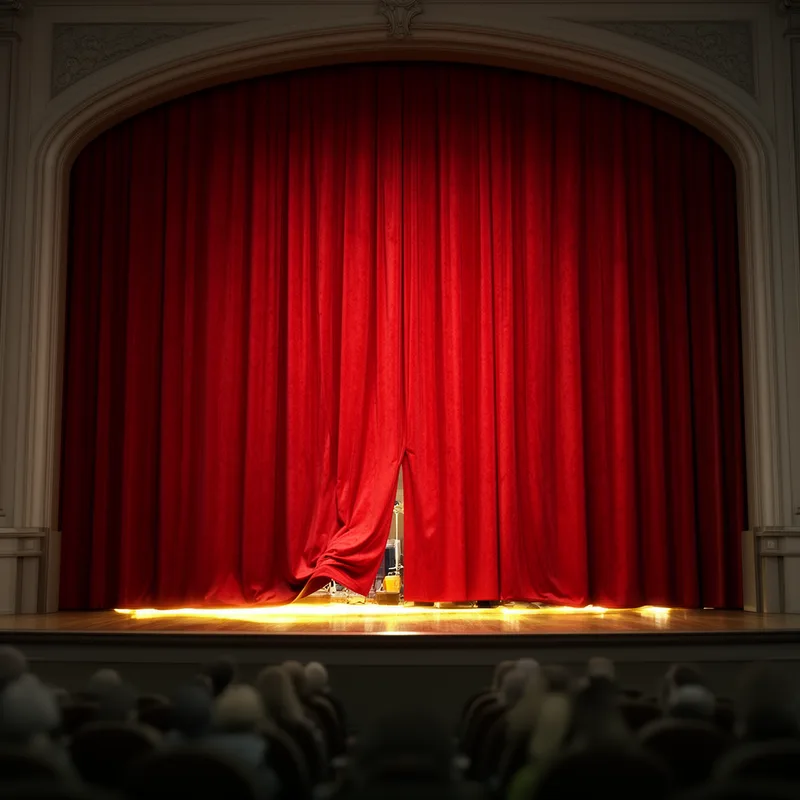
theater curtain
- noun
- /ˈθiːətər ˈkɜːrtən/
- US
- As the lights dimmed, the theater curtain slowly descended to signal the end of the performance.
Examples
-
Siguret points out, quite correctly, that the illustration mirrors the theater because the tablecloth is functioning much as a theater curtain does.
Academic text (1990) -
Just then, accompanied by murmurs as in the first rustling of a theater curtain, the dining room doors swooshed open.
Fiction book (2001) -
The voice rolled on, and behind a gauzy theatre curtain, she saw herself perched on the edge of a cliff, a distant valley sprawling down below.
Fiction book (1996) -
The sky opened up—not like a door this time, but more like a vast theater curtain pulled aside to reveal an immense, unfathomable, star-drenched ocean.
Fiction book (1995) -
The theater curtain rose, revealing a beautifully set stage for the opening scene.
-
Before the show started, the audience eagerly watched the theater curtain waiting to part.
Synonyms

 312
1.0
312
1.0

A piece of hanging cloth used to cover a window
 13
4.6
13
4.6
A piece of cloth like a curtain that hangs in loose folds
 6
7.1
6
7.1
A large painted curtain lowered onto a stage as a background


 1
4.6
1
4.6
A heavy fireproof curtain lowered between the stage and audience to stop a fire from spreading

A large curtain hung above the stage that lowers to make background scenery
A large curtain that people lower from above to make a background on a stage
How Big

Surface Forms
Morphology
The meaning is directly derivable from combining 'theater' (a performance venue) with 'curtain' (a hanging cloth), forming a straightforward noun–noun compound that describes a curtain used in a theater. This compositional pattern is common in English and other languages, so a B1 learner who knows both constituent words would readily understand the phrase.
Etymology
The noun theater curtain comes from the large cloth that hangs in front of a stage and hides the actors. When the curtain rises the show 'begins' and when it closes a scene or the whole performance 'ends', so the name means the cloth that separates the audience and the stage.