
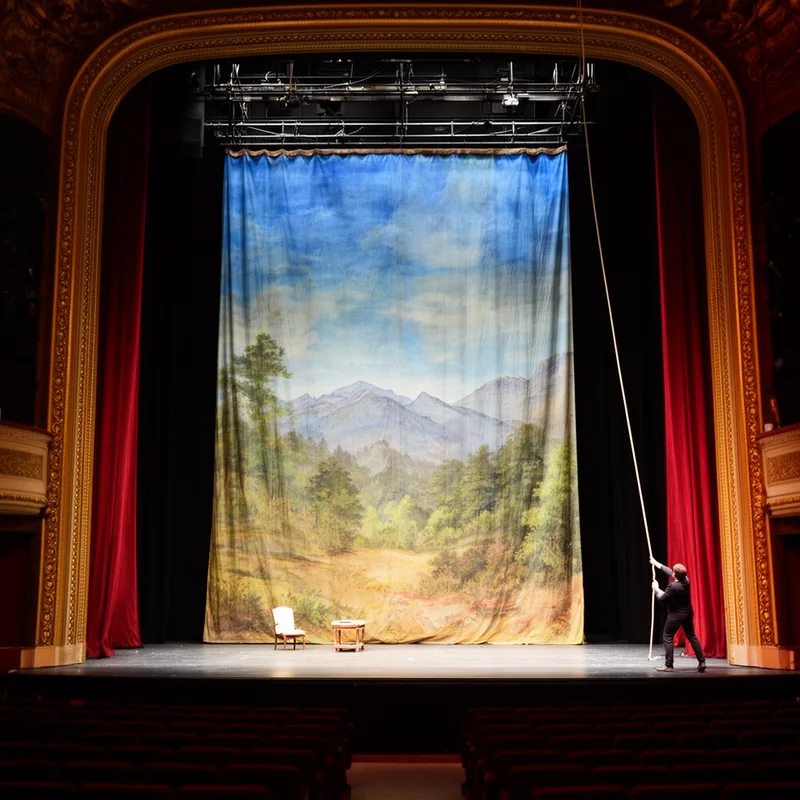
drop curtain
- noun
- Specialized
- The director carefully positioned the drop curtain to enhance the scene's mood.
Examples
-
AND DROP CURTAIN.
-
Now I wish we could duplicate the drop curtain in every area, but it isn't that easy.
-
The actors waited behind the drop curtain for their cue to begin the performance.
-
As the play ended, the drop curtain slowly descended, signaling the end of the show.
Synonyms

 80
3.9
80
3.9

A painted cloth or scene at the back of a stage showing where the story happens
 6
7.1
6
7.1
A large painted curtain lowered onto a stage as a background
A large curtain that people lower from above to make a background on a stage

A large cloth that hangs at the back of a stage as scenery

A large heavy cloth that hides the stage and opens or closes for a show
How Big

Surface Forms
Morphology
The meaning is directly compositional: combining 'drop' (a backdrop) with 'curtain' (a hanging cloth) yields a curtain used as a stage backdrop or one that is lowered onto the stage. While 'drop' as a stage-specific noun is slightly technical, the overall sense is predictable from the constituents and would be understandable to a learner who knows both words.
Etymology
Drop curtain comes from the simple image of a large curtain that is made to drop down from above the stage like a painted picture. It was lowered to show a new scene or to 'hide' the actors, so today it means a curtain lowered from above used as stage 'scenery'.