
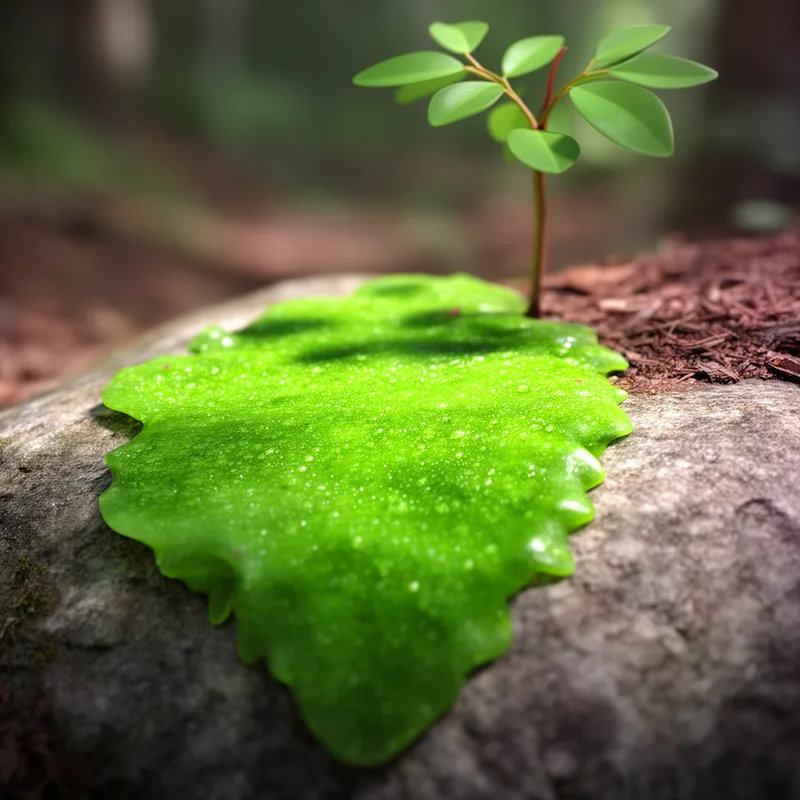
thalloid


 1
9.9
- adjective
- /ˈθælɔɪd/
- Specialized
- Many thalloid plants do not have distinct roots or leaves.
Examples
-
The growth habit of liverworts can be classified as either leafy or thalloid.
-
Some algae possess a distinctly thalloid body, lacking true leaves or roots.
-
Mosses rarely display a thalloid structure, unlike some other primitive plants.
-
The thalloid structure of the algae is fascinating.
-
Some algae possess a distinctly thalloid body, lacking true leaves or roots.
-
Mosses rarely display a thalloid structure, unlike some other primitive plants.
-
The growth habit of liverworts can be classified as either leafy or thalloid.
Synonyms
A plant that has a flat body with no stems or leaves
Has features of simple living things without tubes to carry water, like algae, fungi and lichens
Surface Forms
Morphology
thalloid = thallus (semi-transparent) = thall + oid
The formation is a regular suffixation 'thallus' + '-oid' meaning 'resembling a thallus', so the structural relation is clear.
Etymology
Thalloid comes from the word thallus, which meant 'young shoot' or 'green branch', and the ending -oid, which means 'like' (the same ending you see in asteroid). So thalloid describes a plant body that is 'like' a simple shoot, without a separate stem, root, or leaf.