
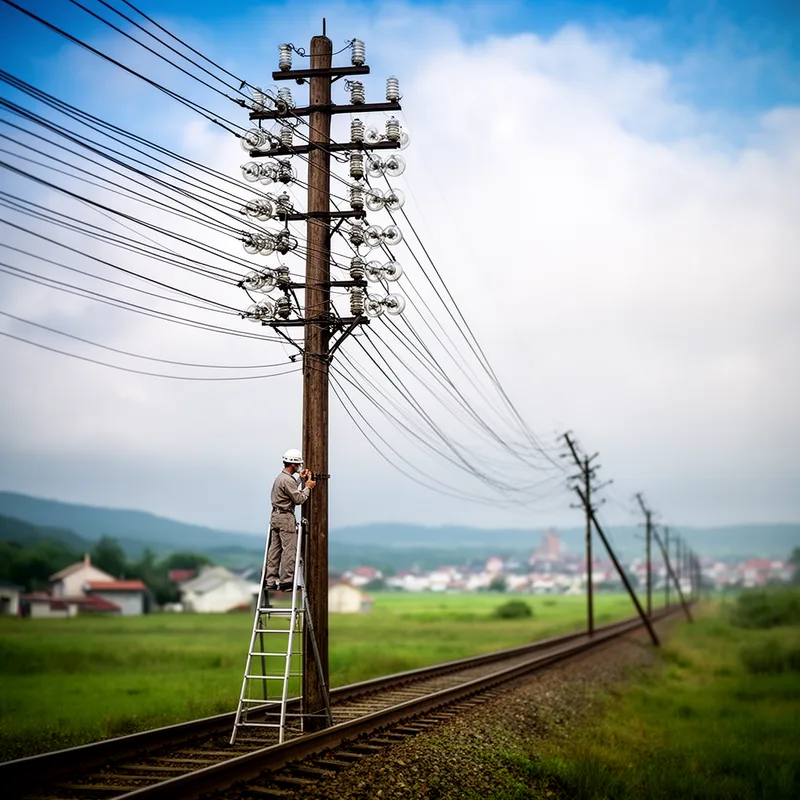
telegraph line
 1
4.5
1
4.5

- noun
- /ˈtɛlɪˌɡræf laɪn/
- Archaic
- The extension of railway and telegraph lines from Lagos port to Osogbo not only strengthened the commercial importance of the city, it also led to a further massive population increase (on the history of Osogbo, see Awe and Albert 1996).
- the first telegraph line
Loading YouTube…
Watch on YouTubeAnd so all the Telegraph lines were knocked out.
- And so all the Telegraph lines were knocked out.
Examples
-
Within a month of his arrival, telegraph lines came to Columbus, which must have been useful for an enterprising photographer.
Academic text (2008) -
The first telegraph line was not strung there until 1862.
Academic text (1999) -
- The telegraph line has been cut.
-
And so all the Telegraph lines were knocked out.
-
And right over there, that's where the telegraph line is.
-
Shortly after war broke out, Stager was given responsibility for all of the telegraph lines in the Ohio military district.
Blog text (28) -
They had repaired a dozen places where the telegraph line had been cut.
Fiction book (1992) -
Dawn was breaking over the curving palms, and the gulls, clustered on the telegraph lines, were waking.
Fiction book (1999) -
Under his command, his troops captured a fort on the St. John's River, disrupted an important railroad and telegraph line, and drew General Beauregard out of Savannah.
Academic text (2005) -
The telegraph line has been cut.
Synonyms
 ∞
3.2
∞
3.2
A connection that carries phone or internet signals
 9
4.1
9
4.1
A cable that carries electricity or data between places
 2
7.2
2
7.2
A cable that carries data or phone signals
 1
4.8
1
4.8
A wire that carries messages or signals over long distances
Surface Forms
Morphology
The meaning is directly and transparently built from 'telegraph' (a system for sending messages) plus 'line' (a wire or cable), so it straightforwardly denotes a wire used for telegraphy. This noun–noun composition follows regular English compounding patterns and is cross-linguistically common, so a B1 learner who knows both constituents should infer the meaning.
Etymology
The noun telegraph line comes from old wires stretched between poles that carried telegraph 'dots and dashes' from one town to another, and so the line came to mean the wire that carried 'messages' over long distances.