

to tease apart
 1
7.0
1
7.0

- phrasal verb
- The relative role of genes and environment would be impossible to tease apart were it not for the natural experiment of identical twins separated at birth and raised in relatively different environments.
Loading YouTube…
Watch on YouTubeNow your data is going to be incredibly important so we can tease this apart and work out what's going on as the situation gets more complicated.
- Now your data is going to be incredibly important so we can tease this apart and work out what's going on as the situation gets more complicated.
- It'd be interesting to try to tease apart whether they have consciousness and what form their intelligence takes.
- So there's a growing body of evidence that says we can't tease apart the exact mechanism by which social media is hurting us.
- So possibly, but it's, it's hard to tease apart kind of what's going on.
- So talk with your clinician, you know, to try to tease those apart.
Examples
-
Quantitative genetic methods, such as twin and adoption methods, were designed to tease apart nature and nurture in order to explain family resemblance.
Blog text (7) -
I tease apart a seam and start to cut down and through.
Fiction book (1998) -
Experiment 2 was designed to tease apart some of the variables that might contribute to these conflicting results.
Academic text (2010) -
Only through this careful research can the impact of hormones be teased apart from the impact of the actual motherhood experience.
Blog text (25) -
The plan is to use the sailboats to tease apart the fundamental properties of flocking.
Blog text (20) -
Furthermore, although the sample size in this study was limited, the PCA framework presented provides a platform from which to tease apart the index and characterize individual ecosystems.
Academic text (2014) -
In material culture studies, science and sympathy can now tease apart two centuries of paint jobs, almost molecule by molecule, and tell us not only that the Washingtons picked a truly bilious green for Mount Vernon's dining room, but why.
Academic text (2005) -
The scientist used fine tools to tease apart the delicate strands of DNA for further study.
-
Before weaving, she had to carefully tease apart the fibers to ensure even spacing in her tapestry.
-
When you make a quilt, you should tease apart the layers to avoid any clumps of fabric.
Synonyms
 513
1.3
513
1.3
To break something into two or more parts
 297
1.9
297
1.9
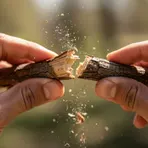
To break into parts or pieces
 50
3.0
50
3.0
To separate something into parts so it can be moved or fixed
 38
4.3
38
4.3
To come apart into threads, like a rope or cloth
 25
6.8
25
6.8
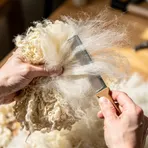
To pull apart and loosen fibers by brushing or combing them
 21
3.2
21
3.2
To break something into pieces by hand
 1
9.9
1
9.9
To cut or separate something into parts, often by breaking it
Antonyms

How Separated

Surface Forms
Morphology
The meaning 'to disentangle and separate fibers or components' is directly derivable from combining 'tease' (to comb/pull/loosen fibers) with 'apart' (into separate pieces); the verb + particle construction transparently signals separation. While 'tease' can also mean 'to mock' in another sense, in the literal textile/assembly sense the phrase is compositional and a B1 learner who knows the constituent senses would readily infer the MWE's meaning.
Etymology
Tease apart comes from working with wool and thread: to tease meant to pull fibers with a small comb to loosen knots and apart shows the pieces were pulled away from each other. So, the phrase now means 'to separate parts carefully'.