
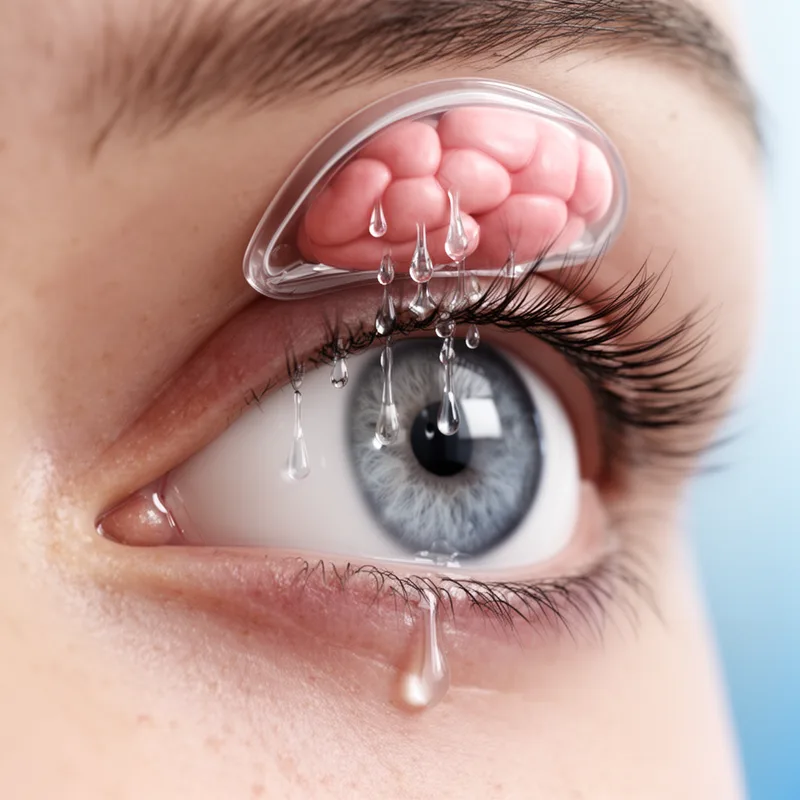
tear gland
- noun
- /tɪr ɡlænd/
- Specialized
- If you're sensitive or bad at controlling your tear glands, you might want to prepare tissues or something.
Examples
-
It was as if the tear glands had loosened.
Fiction book (1992) -
He might even be fighting to keep his tear glands from giving him away.
Fiction book (1999) -
In women, he was learning, the tear glands of the eye attach not only to the nose but to the summer porches and gazebos of the ear, where language loiters.
Fiction book (1998) -
When I cried during the movie, my tear glands produced a lot of tears.
-
Her tear glands were overactive, causing her to tear up at the slightest emotion.
-
The doctor explained how the tear glands help keep our eyes moist and healthy.
Synonyms



 1
5.8
1
5.8
A small part near the top outer corner of the eye that makes tears

A small part near the top outer corner of each eye that makes tears to keep the eye wet
Surface Forms
Morphology
The noun–noun compound is fully compositional: 'tear' (a drop from the eye) combined with 'gland' (an organ that secretes fluids) yields a gland that produces tears. This follows a common English compounding pattern and is cross-linguistically transparent, so a B1 learner who knows both constituents will readily infer the meaning.
Etymology
Tear gland names the small body part that makes 'tears' in the eye. It joins the words tear, meaning the salty water from your eye, and gland, meaning a small part that produces liquid, so the phrase simply means 'the part that produces tears'.