
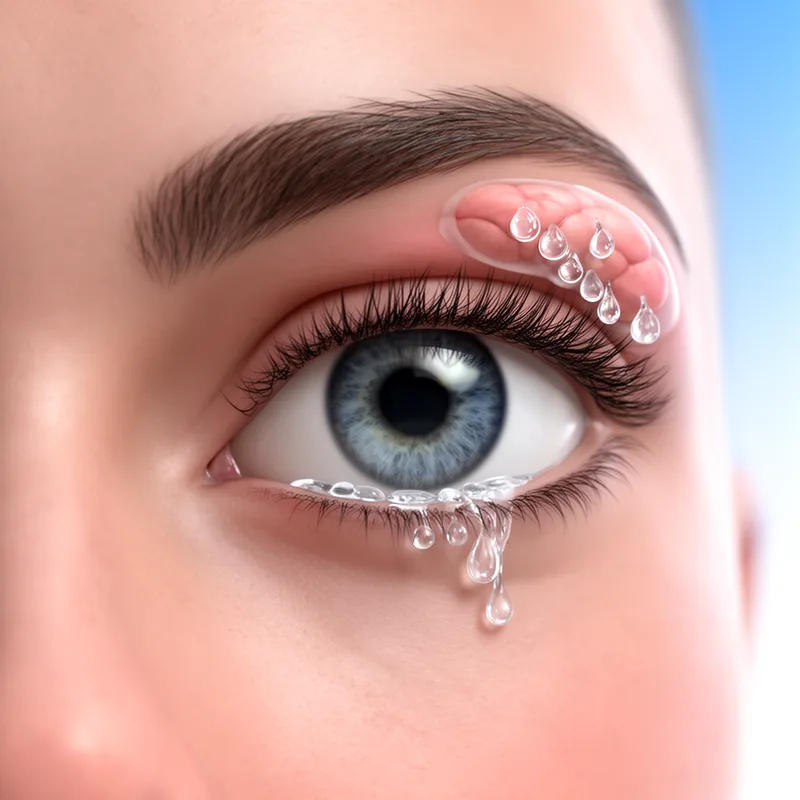
lacrimal gland


 1
5.8
- noun
- /ˈlækrɪməl ɡlænd/
- Specialized
- Some lacrimal gland oncocytomas, though rare, are malignant.
Loading YouTube…
Watch on YouTubeAnd so how your eye works is your lacrimal glands secrete a water based tear, right?
- And so how your eye works is your lacrimal glands secrete a water based tear, right?
Examples
-
The secretions of the lacrimal gland containing oils, salts, proteins, and stress hormones.
-
The lacrimal gland may also harbor this tumor, albeit very rarely.
Academic text (1995) -
And so how your eye works is your lacrimal glands secrete a water based tear, right?
-
And this nerve sends a signal directly to your lacrimal gland, which produces most of your tears.
-
Homogeneous contrast enhancement on the right lacrimal gland was also noted.
Academic text (2008) -
Primary epidermoid carcinoma of the orbit results from SCC of the lacrimal gland, which is a rare entity.
Academic text (2008) -
On the contrary, it has not been found in the lacrimal gland (unpublished observations). PRP immunoreactivity was present in this tumor but was not marked.
Academic text (1995) -
The lacrimal gland is responsible for producing tears when we feel emotional.
-
Whenever dust gets into my eyes, my lacrimal glands start to produce tears to wash it away.
-
The doctor explained how the lacrimal gland works to keep our eyes moist and healthy.
Synonyms
 1
2.7
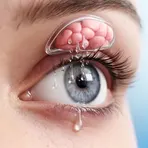
A small part of the eye that makes tears
 1
8.4
A small part near the top outer corner of each eye that makes tears to keep the eye wet
Surface Forms
Morphology
The meaning 'a gland that produces tears' is directly and compositionally derived from 'lacrimal' (relating to tears) + 'gland' (an organ that secretes fluids). This is a transparent technical compound whose sense follows regular morphological composition and would be clear to a B1 learner who knows both constituent meanings.
Etymology
Lacrimal gland comes from an old word lacrimal meaning 'tear' and gland meaning a small body part that makes liquid. It sits above the outer part of the eye and makes your tears, so the name literally means 'the part that makes tears'.