
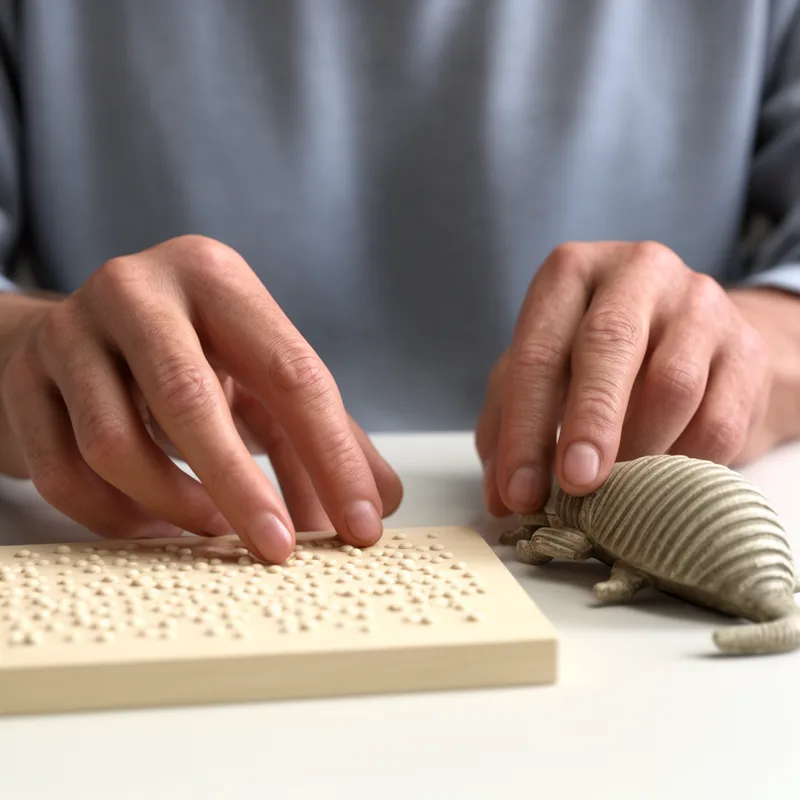
tactually


 1
9.9
- adverb
- /ˈtækʧuəli/
- Specialized
- Even though she could tactually identify the Braille alphabet letters, she wanted to read print like the other children.
Examples
-
She can tactually identify different textures by feeling them.
-
Code keys can be inserted tactually.
Academic text (2001) -
A third possible intervention would be the systematic use of tactually interesting objects.
Academic text (1997) -
If a child cannot see, it does mean that we cannot present a visual task tactually and assume the results measure the same cognitive process or operation.
Academic text (2001) -
Because he was able to tactually encode the information, he could transfer that meaning to his visual perceptions.
Academic text (1991) -
Rational: Just as many totally blind people will reach out and touch something without attempting to explore the entire object tactually, most low vision students look at an image and settle with the very first information they see.
Academic text (1997) -
Monitor touch pads can also be visually or tactually adapted by using high contrast or tactile markers such as puff paint, bump dots, raised dots, or Hi-Marks.
Academic text (2001) -
Children learn to read tactually using Braille books designed for touch.
-
The artist created a tactually stimulating sculpture that invites people to touch it.
Synonyms
 1
7.6
By touching something to feel its shape or texture
In a way that uses the sense of touch
Surface Forms
Morphology
Etymology
Tactually comes from the root tact-, which means 'to touch' and is the same base you see in tactile and contact. So to do something tactually is to do it by touch rather than by sight.