

swath of destruction
 1
6.5
1
6.5

- noun
- /swɔθ əv dɪsˈtrʌkʃən/
 :
franja de destrucción
:
franja de destrucción
- a wide swath of destruction
Examples
-
The 20th century's first revolution was in Mexico, and, like the second in Russia, it was cataclysmic: humbling the upper class, mobilizing the peasants, and cutting a wide swath of destruction.
Academic text (1990) -
Hurricane Sandy visited the neighborhood and left a swath of destruction and death, some of it still to be discovered.
-
An estimated 1,000 tornadoes touch down in the United States every year, creating swaths of destruction and claiming scores of lives.
-
Hurricane Georges cut a swath of destruction 40 miles wide, hitting the Caribbean, then the U.S. Virgin Islands, and then the Florida Keys and the Florida Gulf.
Synonyms
 849
3.0
849
3.0
Severe damage that makes something no longer exist or cannot be fixed
 110
4.3
110
4.3
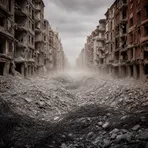
Great damage to a wide area often caused by war or a big disaster
 90
4.8
90
4.8
Great destruction that leaves places badly damaged, for example after a war or storm
 3
3.8
3
3.8
Serious harm that affects a large area or many things
 1
4.8
1
4.8
Damage across a large area that destroys buildings and homes

A state of complete destruction that leaves a place ruined
Antonyms


How Extensive

Surface Forms
Morphology
swath + of + destruction
The phrase is directly compositional: 'swath' denotes a broad strip or area and 'destruction' denotes serious damage, so together they literally mean a wide area of damage. The noun + of + noun composition is a common, predictable pattern cross-linguistically, so a B1 learner who knows both constituents would be able to infer the meaning.
Etymology
The phrase swath of destruction comes from the image of a farmer cutting a long strip across a field. The clear swath, a long strip, and destruction, 'damage', give a strong picture of a wide area ruined, so the phrase means 'a wide area' where things are badly damaged.