
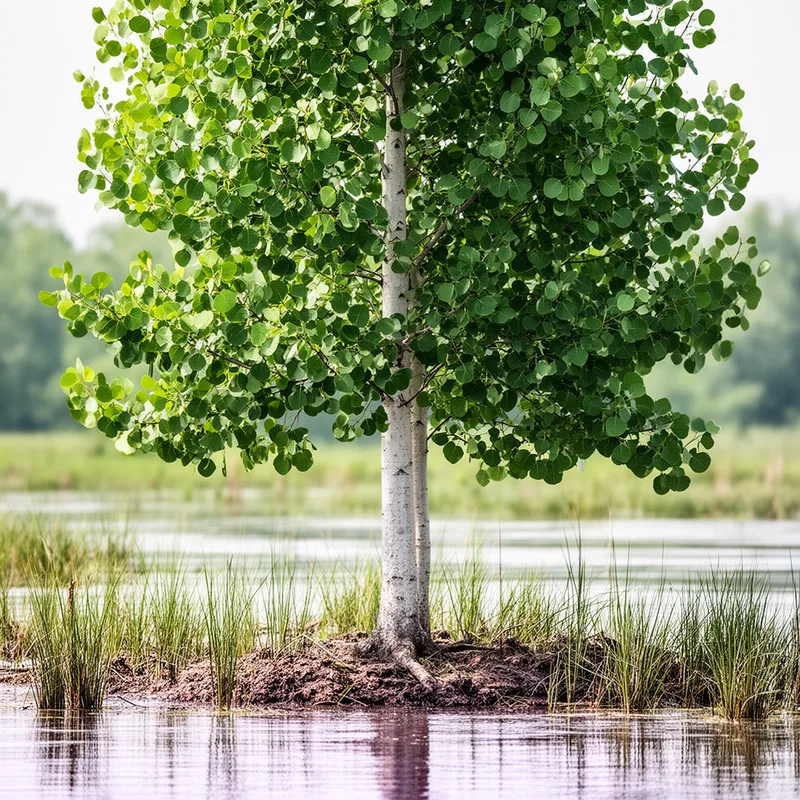
swamp cottonwood
- noun
- /swɑmp ˈkɑtənˌwʊd/
- Specialized
 :
álamo de pantano
:
álamo de pantano
- The broad leaves of the swamp cottonwood provided shade on the humid summer day.
Examples
-
The swamp cottonwood thrives in the wet lowlands along the riverbanks.
-
The swamp cottonwood thrives in wetland areas.
-
We identified several swamp cottonwood trees during our ecological survey of the marsh.
-
Many swamp cottonwoods grow along the riverbanks.
-
The swamp cottonwood tree thrives in wetland areas, where its broad leaves provide shade.
-
In the southern United States, swamp cottonwood is commonly found along riverbanks and swamps.
-
The bark of the swamp cottonwood is brownish and rough, making it distinct among other trees.
Synonyms
A North American poplar tree with large leaves with wavy edges and brown bark often found in swamps

A tree that grows in wet places like rivers and marshes with large rounded leaves and brown bark

A poplar tree from North America with large soft rounded leaves with wavy edges and brown bark
Surface Forms
Morphology
The compound is a straightforward noun–noun composition where 'swamp' specifies the habitat of the head noun 'cottonwood', so the meaning (a cottonwood that grows in swampy/wetland areas) is directly inferable from the parts. This locative-modifier pattern is common cross-linguistically and follows regular English compounding, making it immediately comprehensible to learners who know both constituents.
Etymology
Swamp cottonwood is a very literal name: a cottonwood tree that grows in a swamp or other very wet places. The tree makes fluffy, cotton-like seeds, so the name helps you remember it means 'a cottonwood that lives in wet ground'.

