
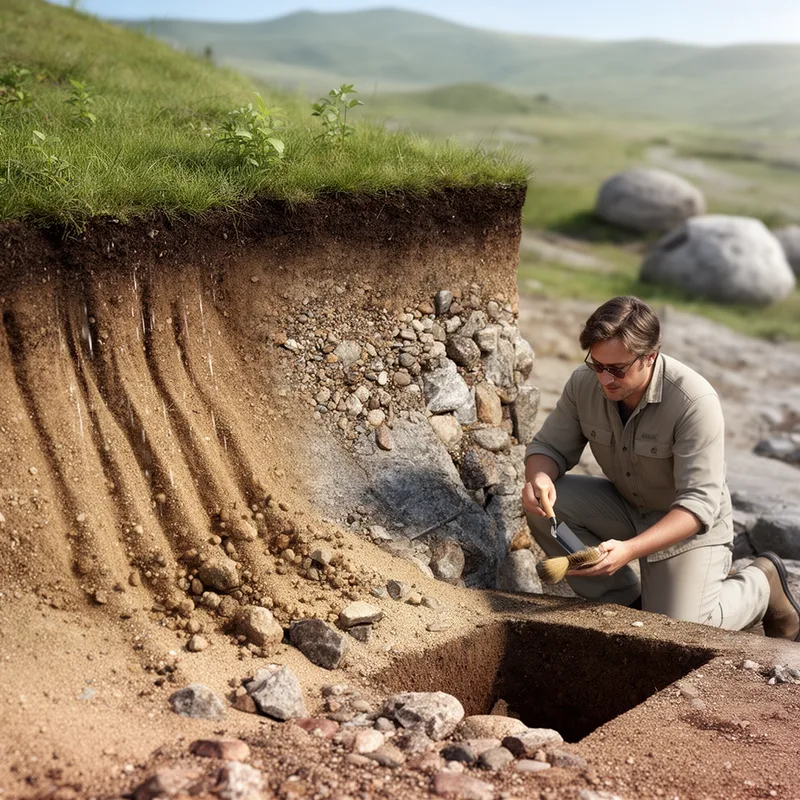
surficial


 1
9.5
- adjective
- /sɜrˈfɪʃəl/
- Specialized
- During the austral summer, dark bands that border the streams can be seen (Figure 2); these moist areas, which develop as the summer progresses, are the surficial manifestations of the hyporheic zone.
- surficial sediments
Examples
-
In fact, some lakes displayed higher concentrations of arsenic in surficial sediments than in tailings directly below them.
Academic text (2018) -
The scientists studied the surficial layers of soil to understand the environmental changes over time.
-
Many species require habitats associated with particular surficial conditions.
Academic text (2012) -
Surficial aquifer sources also may have water quality concerns caused by a high organic content and the potential for pollution.
Academic text (2001) -
Most of the samples with arsenic concentrations greater than 15 mg/kg occurred in surficial sediments.
Academic text (2018) -
Almost all of the farming areas in the North Island hill country are still prone to soil slippage, involving surficial translational displacement of regolith.
Academic text (1991) -
The stabilization of pastoral slopes susceptible to deep-seated landsliding has proved much more difficult than where only surficial movements occur.
Academic text (1991) -
Preceded by a prolonged wet spell, the storm induced surficial landsliding on 35,000 hectares of hill pastures.
Academic text (1991) -
The surficial features like rivers and valleys play a crucial role in shaping the landscape.
-
After the rain, the surficial runoff affected the nearby ecosystems and water quality.
How Shallow

Surface Forms
Morphology
Etymology
Surficial comes from the word surface, which itself comes from the Latin parts super- 'above' and facies 'face'. So surficial means 'on' or 'near' the top or outer face of the ground, which is why scientists use it for soils and deposits at the top layer.