

surface tension
 5
4.3
5
4.3

- noun
- /ˈsɜrfɪs ˈtɛnʃən/
- Specialized
- The scientist demonstrated how surface tension allows water droplets to bead up on a waxed car hood.
- high surface tension
- surface tension of water
- low surface tension
Loading YouTube…
Watch on YouTubeSo whether it's crops or livestock, they're consuming healthier water where we lower the surface tension and all these cool things.
- So whether it's crops or livestock, they're consuming healthier water where we lower the surface tension and all these cool things.
- Well, usually a surfactant of some sort to reduce surface tension, to make it more easily penetrate.
- And if the surface tension of the balloon is not strong enough, it can RIP apart in that phase before it goes to the higher frequency.
Examples
-
OK, so now the laws of surface tension help us create soap bubbles.
-
The throbbing interaction appears to be an interplay between surface tension and evaporation.
Blog text (28) -
So the surface tension is how much energy I need to create a surface.
-
The most important factor here is surface tension, which is an effect of the polarity of water molecules.
Blog text (34) -
But for marine microbes to get airborne, they must escape the surface tension of water -- no easy task.
Academic text (2009) -
The resulting liquid sheet has a cusped rim due to an instability caused by surface tension.
Academic text (2006) -
Stable hydrogen bonds also lead to the strong cohesive forces underlying the unusually high surface tension of water.
Academic text (2007) -
With less surfactant, the surface tension of the droplet tightens again, and the droplet contracts.
Blog text (28) -
The water strider can walk on the surface of the pond due to surface tension.
-
Adding soap to water reduces its surface tension, making it easier to wash dishes.
Synonyms

A pull at the surface between two liquids that do not mix, like oil and water
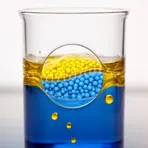
The force at the surface between two liquids that do not mix, like oil and water
Surface Forms
Morphology
The meaning ('the tightness or contracting tendency of a liquid's surface') is directly derivable from combining 'surface' (outer/top layer) and 'tension' (tightness/force); it denotes the presence of tension at the surface. Although it is a scientific term, the noun+noun composition follows common, cross-linguistic logic, so a B1 learner who knows both constituents should be able to infer the meaning.
Etymology
Surface tension comes from imagining the top of a liquid acting like a tight skin: surface means the top and tension means a tight pull. This 'skin' 'pulls itself tight', forming drops and letting small insects walk, so the term means the liquid's top layer pulling together.