
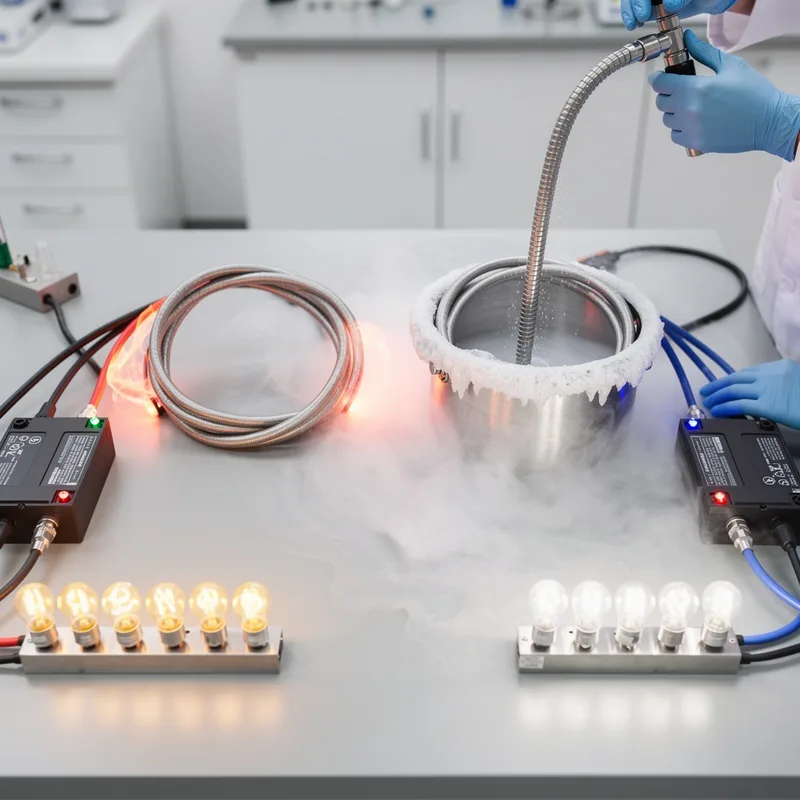
to superconduct
 4
8.2
4
8.2

- verb
- /ˌsuːpərˈkɒndʌkt/
- Specialized
- When cooled to near absolute zero, certain materials can superconduct and allow electricity to flow without resistance.
- superconducting magnet
- superconducting transition
- superconducting motor
Loading YouTube…
Watch on YouTubeSo still not quite practical, but the point is, there could be a material out there that superconducts at room temperature and room pressure.
- So still not quite practical, but the point is, there could be a material out there that superconducts at room temperature and room pressure.
Examples
-
Scientists are experimenting with materials that can superconduct under higher temperatures to improve energy efficiency.
-
The team worked on a project that aimed to superconduct materials for use in advanced magnetic resonance imaging systems.
-
It's superconducting at room temperature.
-
You need a superconducting sensor.
-
In Japan, a prototype system uses superconducting magnets inside the trains.
Academic text (2002) -
It's a superconducting chip.
-
A major part of the RHIC construction effort consisted of producing the superconducting magnets.
Academic text (1999) -
Educators can use items as different as bananas and superconducting magnets to demonstrate this scientific principle.
Academic text (2002) -
Researchers achieve coherent coupling between a superconducting quantum bit and a single microwave photon.
Academic text (2004) -
In Erlangen, Germany, Siemens started a 400-kilowatt machine, calling it Europe's first superconducting motor.
Academic text (2001)
Antonyms

How Conductive

Surface Forms
Morphology
Etymology
Superconduct comes from super- meaning 'above' or 'very' and conduct meaning 'to carry', the same root you see in conductor. So to superconduct is to carry electricity so well that electric current flows with no resistance, like a 'super' highway for electricity.