

styloid process
- noun
- /ˈstaɪlɔɪd ˈprɑːsɛs/
- Specialized
- The surgeon explained that the styloid process extends from the skull and serves as an important anatomical landmark.
- elongated styloid process
- resection of the styloid process
- length of the styloid process
Examples
-
We then obtained 3-D CT, which revealed that both styloid processes were elongated.
Academic text (2006) -
Through a left parotidectomy-type incision, the surgeon removed the left styloid process, which resulted in complete relief of her pain.
Academic text (1996) -
Intraoperatively, the length of both styloid processes was 40 mm.
Academic text (2006) -
The naked and free styloid process was removed from the temporal bone at its origin.
Academic text (2006) -
At 40 mm, the length of our patient's styloid processes greatly exceeded the 25-mm threshold of normal.
Academic text (2006) -
The reported prevalence of elongated styloid processes ranges between 1.4% and 30%.
Academic text (2006) -
Based on these findings, the patient was scheduled for resection of the styloid processes via a transoral approach.
Academic text (2006) -
In this article, we present a case of Eagle's syndrome that was caused by bilaterally elongated styloid processes.
Academic text (2006) -
CT images allow physicians to appreciate both the bony anatomy and the relationship of the styloid process to critical neurovascular structures.
Academic text (2008) -
A diagnosis of left Eagle's syndrome (a rare painful elongated styloid process) had been made by her physician.
Academic text (1996)
Synonyms


 1
8.4
1
8.4
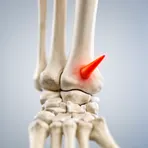
A small pointed part that sticks out from a bone
Surface Forms
Morphology
The meaning is directly compositional: 'styloid' denotes a slender, tapered shape and 'process' denotes a projection, so together they describe a slender bony projection. This follows regular anatomical naming patterns that are predictable and likely understandable to a B1 learner who knows both constituent words.
Etymology
Styloid process gets its name from old words: styloid comes from a word for a thin 'pillar' or 'stake', and process means 'something that sticks out'. That's why the name paints the picture of a thin, pointed bone that sticks out from the skull and is a 'place where muscles attach'.