

styloid
- adjective
- /ˈstaɪlɔɪd/
- Specialized
- In anatomical diagrams, the styloid structures are often depicted as slender and elongated.
- styloid process
- elongated styloid
- resection of the styloid
Examples
-
Numerous therapeutic approaches, both conservative and invasive, have been used to treat Eagle syndrome in the setting of an elongated styloid process.
Academic text (2008) -
The styloid process is a bony outgrowth of the temporal bone that extends, by means of the styloid ligament, toward the lesser cornu of the hyoid bone.
Academic text (2008) -
Based on these findings, the patient was scheduled for resection of the styloid processes via a transoral approach.
Academic text (2006) -
Photograph shows a representative specimen obtained by transcervical resection of the styloid process in this study.
Academic text (2008) -
Several imaging modalities of the cervical region have been used to identify an elongated styloid process.
Academic text (2006) -
The styloid process is skeletonized during surgical resection via the transoral approach.
Academic text (2006) -
The styloid process on the left was 41.5 mm (Figure 1, A), and the styloid process on the right was 42.5 mm (Figure 1, B).
Academic text (2006) -
Five of the six patients had undergone transcervical resection of the styloid process; the remaining patient had been offered surgical treatment and declined.
Academic text (2008) -
Eagle syndrome represents a constellation of symptoms, most notably facial pain, that is believed to be related to an elongated styloid process.
Academic text (2008) -
The estimated length of the styloid processes on preoperative 3-D CT in this case correlated well with the actual length measured intraoperatively.
Academic text (2006)
Synonyms

 71
1.0
71
1.0

A thing with a sharp tip

Long, very thin, and pointed like a needle
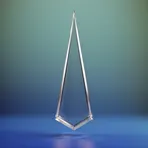
A shape that is pointed, gets narrow, and ends in a sharp tip
Compounds

- Specialized
A slender, pointed part of a bone at the base of the skull that muscles attach to
How Pointed


Surface Forms
Morphology
Etymology
Styloid comes from an old Greek root styl- meaning 'pillar' or 'stake' and the ending -oid meaning 'like'. Think of a small pillar or the pointed tip of a stylus, a thin writing tool, so styloid means 'like' a thin, pointed shape and is used for slender, pencil-like parts in the body.