
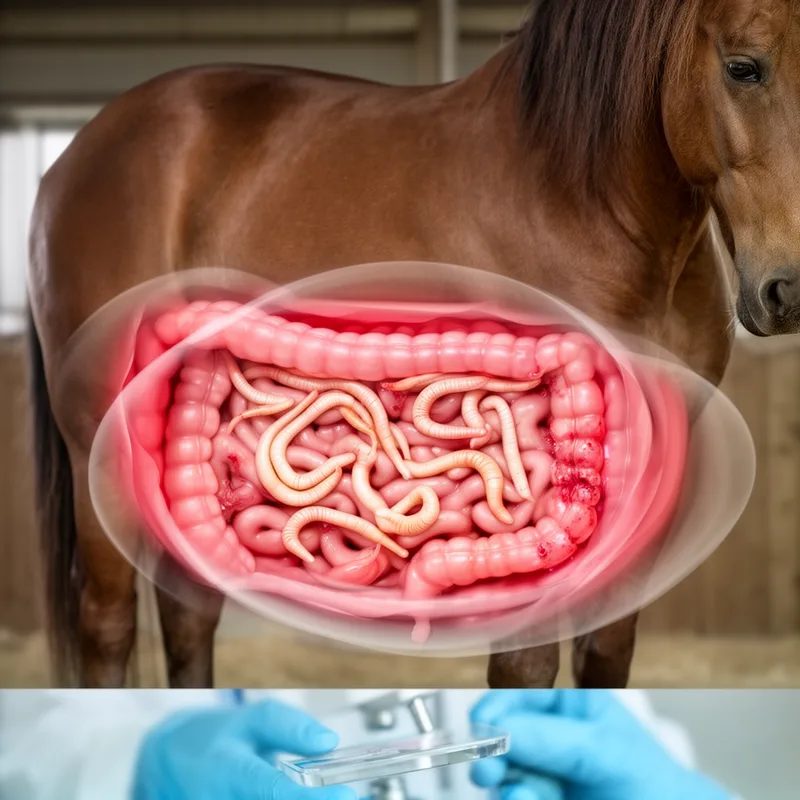
strongyle
- noun
- /ˈstrɒŋɡaɪl/
- Specialized
- The main clinical sign in small strongyle infection is weight loss (Love et al., 1999).
- small strongyles
- large strongyles
- strongyle eggs
Examples
-
The Baermann technique is also a successful method for the recovery of small strongyles' immature larvae in the faeces of clinically diseased horses.
Academic text (2015) -
Infections of strongyles often result in symptoms such as diarrhea and fatigue in animals.
-
For small strongyles, the life cycles of individual species have also not yet been determined.
Academic text (2015) -
The damage caused by large and small strongyles is attributed to larval stages.
Academic text (2015) -
The pattern of larval migration among large and small strongyles differs.
Academic text (2015) -
Strongylus vulgaris, one of the large strongyles, is the most prevalent and pathogenic.
Academic text (2015) -
More than 50 species of equine strongyles have been reported (Lichtenfels et al., 2002).
Academic text (2015) -
The encysted larvae of small strongyles can emerge synchronously from the intestinal wall, leading to the clinical disease called 'larval cyathostominosis.'
Academic text (2015) -
Small strongyles can cause weight loss in infected horses, making prompt diagnosis important.
-
Veterinarians recommend regular deworming to manage strongyle infestations in livestock.
Synonyms

 3
5.5
3
5.5

A long round animal pointed at both ends that sometimes lives as a parasite
A small round worm that lives in the intestines of farm animals
Surface Forms
Etymology
Strongyle comes from the old Greek word strongylos, which means 'round'. That's a helpful memory because these parasites are round in shape, so a strongyle is a roundworm that often lives in the intestines of animals.