
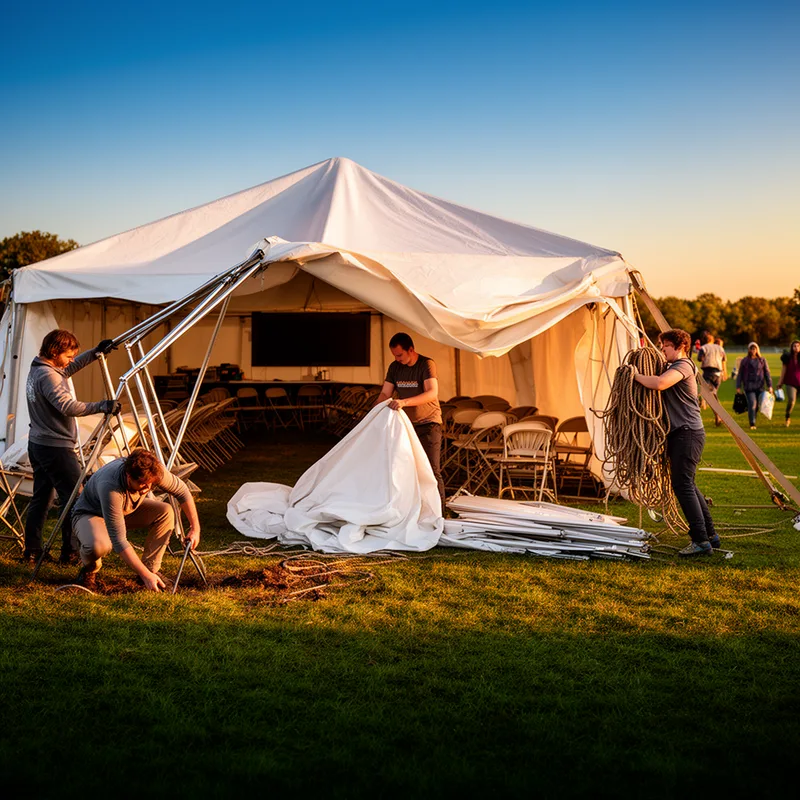
to strike the tent
- phrasal verb
- Archaic
- Before leaving the campsite, it was time to strike the tent and clean up the area.
Examples
-
The only thing I gathered, while I was tying up my pirogue, was that we had to strike the tent and go to the Amber Hole, a cave where—according to this guy—
Fiction book (2001) -
After the last day of the festival, we need to strike the tent and pack everything up.
-
As the sun began to set, the campers decided to strike the tent and head home.
Synonyms

 175
8.4
175
8.4

To leave a place quickly or suddenly
 112
3.4
112
3.4
Leave a place suddenly because you are angry or protesting
 37
3.5
37
3.5
To leave a place suddenly to show you are angry or upset
 4
3.4
4
3.4
Pack your things and leave a camp at the end of your stay

To stop trying and leave a situation quietly
Antonyms

Surface Forms
Morphology
The literal sense 'to take down a tent' follows directly from combining 'strike' (remove or dismantle) with 'tent' (a collapsible shelter), so the basic meaning is compositionally transparent. The extended figurative sense 'to leave or bring an event to an end' is a predictable metonymic extension of breaking camp and is cross-linguistically common, so learners who know the constituents can generally infer the usage.
Etymology
Strike the tent comes from camping and army life, where to strike a tent meant to pull up the pegs and fold the tent so it was gone. One clear picture is people packing the tent to move on, so the phrase now means 'to take down a tent' or 'to leave' or 'to end an event'.