
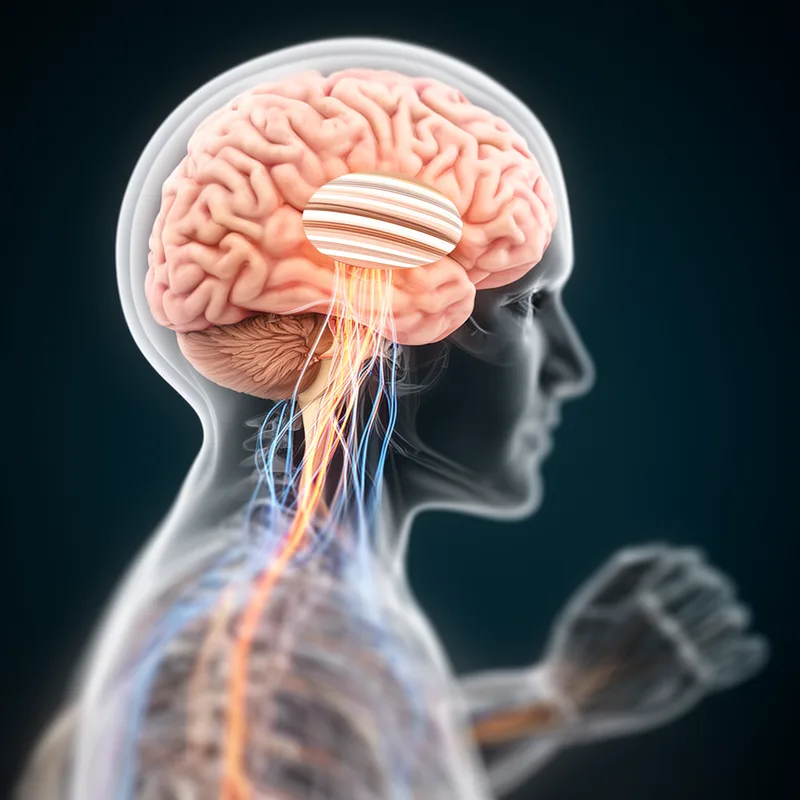
striate body
- noun
- /ˈstraɪ.eɪt ˈbɑː.di/
- Specialized
- The striate body plays a crucial role in regulating voluntary movement.
Examples
-
Damage to the striate body can lead to disorders such as Parkinson's disease.
-
Research on the striate body has advanced our understanding of motor control in the brain.
-
The striate body plays a crucial role in motor control.
-
Researchers study the striate bodies to understand brain functions.
-
Damage to the striate body can lead to disorders such as Parkinson's disease.
-
Research on the striate body has advanced our understanding of motor control in the brain.
-
The striate body plays a crucial role in regulating voluntary movement.
Synonyms

 1
9.9
1
9.9

A part of the brain that helps control movement and reward

 1
9.1
1
9.1
A part of the brain made of two connected areas that helps control movement
Surface Forms
Morphology
Although 'striate' literally means 'marked by parallel grooves' and 'body' means a main part, the compound 'striate body' denotes a specific anatomical brain structure (caudate + lenticular nuclei) that is a specialized technical term rather than a predictable ‘grooved main part’. A B1 learner who knows the constituents would not be able to derive this precise neuroanatomical meaning from the parts alone, so the expression is effectively opaque.
Etymology
The noun striate body comes from striate meaning 'striped' and body meaning 'a mass'. It was named because this part of the brain has light and dark bands of white and grey that look striped, so the name points to its appearance and to the brain area that helps control movement.