
stratigraphically


 1
9.9
- adverb
- /ˌstrætɪˈɡræfɪkli/
- Specialized
- The fossils were analyzed stratigraphically to understand the order of the layers in which they were found.
Examples
-
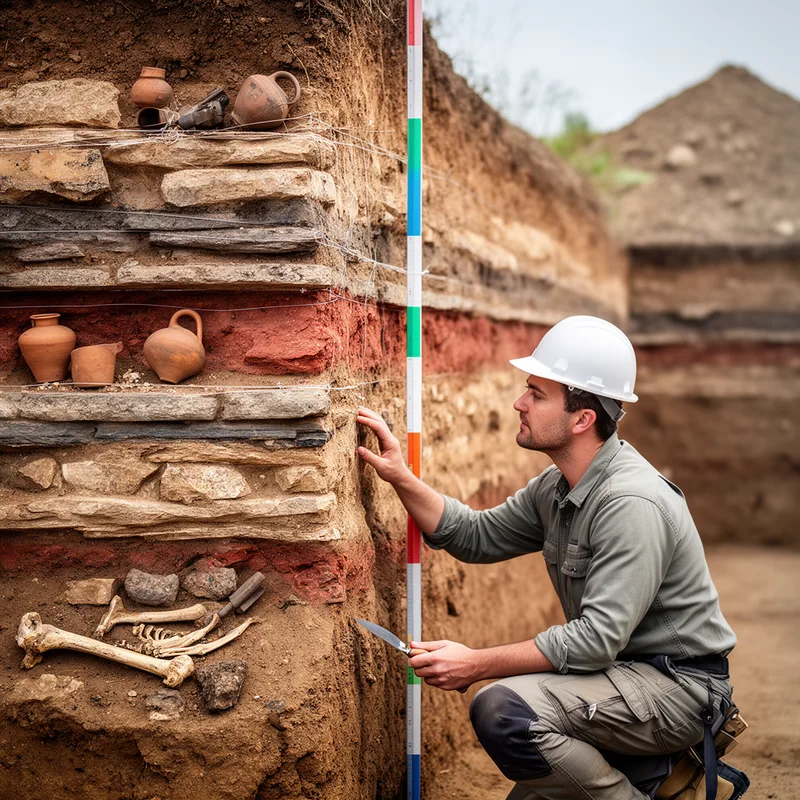
Archaeologists studied the site stratigraphically, revealing how different civilizations built atop one another over centuries.
-
This is really a very simple field, fully contained stratigraphically, and it's given us no real problems.
Fiction book (1995) -
"In some cases," Conard wrote last year, "these production spikes can lead to younger dates stratigraphically underlying older dates from secure contexts."
Academic text (2007) -
There is no question in my mind that, given the archaeological clarity of past disasters, future scholars will be able to stratigraphically distinguish pre-K (as residents humorously dub it) and post-K New Orleans.
Academic text (2006) -
The geologist explained how the rocks were deposited stratigraphically over millions of years in distinct layers.
Surface Forms
Morphology
stratigraphically = stratigraphic (semi-transparent) = stratigraphy + ic + ally
Formation is regular (stratigraphy → stratigraphic → stratigraphically), but the base 'stratigraphy' is a technical geological term and the combining form is not common to average learners.
Etymology
The word stratigraphically comes from parts that mean 'layer' and 'to write': strata ('layer') and graph ('write'), the same graph in photograph and autograph. So, to study something stratigraphically is to look at it 'by layers' to understand the order of events.