

stomate
- noun
- /ˈstoʊmeɪt/
- Specialized
- This capability to continue opening stomates during extreme water stress is probably what predisposes these plant species to live in arid habitats.
Examples
-
The stomates on the underside of leaves allow for gas exchange, letting carbon dioxide in and oxygen out.
-
They have also found that it helps fescue close its leaf stomates quicker to conserve moisture in a drought, as well as improve growth efficiency.
Academic text (2000) -
During the course of a day, the water-use efficiency of many desert plants characteristically decreases from midmorning, when net photosynthesis is typically highest, to late afternoon, when the photosynthetic rate can be substantially lower but stomates are still open.
Academic text (1998) -
Ozone comes into contact with plants through "stomatal conductance," or the uptake of ozone through small pores on a leaf or stem (stomates).
Academic text (2003) -
In order to reduce water loss, many plants regulate the opening and closing of their stomates based on the surrounding humidity.
-
Stomates are essential for photosynthesis as they enable plants to absorb carbon dioxide from the air.
Synonyms

 2
5.8
2
5.8

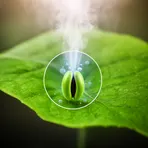
A tiny opening on a leaf or stem that lets gases and water vapor pass

 1
8.2
1
8.2
Tiny opening on a leaf or stem that lets air and water vapor pass
Surface Forms
Etymology
Stomate comes from the Greek root stoma, which means 'mouth'. So, a stomate is like a tiny 'mouth' on a leaf that opens and closes to let gases and water pass in and out.