

pore
 2
5.8
2
5.8

- noun
- /pɔr/
- Plants decrease the number of stomata or air pores on their leaf surfaces in response to increasing atmospheric levels of CO2.
- leaf pore
- stomatal pores
Examples
-
This gas gradually filters upward through soil pores and cracks until it is released into the air," Harper says.
Academic text (1995) -
And as the pore size gets smaller, the speed goes up.
-
And that's the initial pore size through which the gas must flow.
-
And there's a slide showing you the nuclear pores coming up next.
-
CAM provides a selective advantage by allowing terrestrial plants to close their stomata (leaf pores) during the day and open them at night.
Academic text (1998) -
Ozone comes into contact with plants through "stomatal conductance," or the uptake of ozone through small pores on a leaf or stem (stomates).
Academic text (2003) -
The leaf has tiny pores that allow moisture to escape into the air.
-
In the stem of the plant, small pores facilitate gas exchange during photosynthesis.
-
The wall is designed with many tiny pores to improve ventilation in the building.
Synonyms

 1
8.2
1
8.2
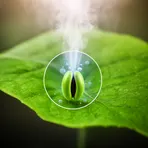
Tiny opening on a leaf or stem that lets air and water vapor pass

A small hole on a leaf or stem that lets air and water move in and out
Antonyms

Compounds



- Specialized
A kind of mushroom that grows on dead wood and has a pore-covered surface that releases spores

- Specialized
A woody mushroom with many small tubes or holes under it that hold spores

Surface Forms
Etymology
Pore (in plants) comes from the old Greek word poros, meaning 'passage' or 'small hole'. That's why the tiny openings on leaves are called pores: they are small passages that let gases and water vapor move in and out.