

stellar parallax
- noun
- /ˈstɛlər ˈpærəˌlæks/
- Specialized
- Astronomers calculate a star's distance from Earth by observing its stellar parallax over the course of a year.
Examples
-
How does stellar parallax help astronomers determine distances?
-
Because stellar parallax is so tiny for distant stars, powerful telescopes are needed to detect it.
-
The first measurement of stellar parallax provided crucial evidence for the heliocentric model of the solar system.
-
The concept of stellar parallax was crucial for measuring star distances.
-
Astronomers use stellar parallax to determine how far away a star is by observing its apparent shift in position as Earth orbits the Sun.
-
The concept of stellar parallax is essential for calculating the distances to nearby stars accurately.
-
By measuring stellar parallax, scientists can estimate the distance between Earth and various stars in our galaxy.
Synonyms
 4
9.5
4
9.5

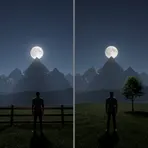
A change in where something looks when you see it from two places, for example the moon

A small change in a star's position when Earth moves around the Sun that shows how far away it is

A small shift in a star's position seen when Earth is at different places around the sun to measure distance
Surface Forms
Morphology
The compound is directly compositional: 'stellar' specifies the domain ('of stars') and 'parallax' denotes an apparent displacement from different viewpoints, so the phrase literally means the apparent displacement of a star. This follows a standard modifier+noun pattern (common across languages), so a B1 learner who knows both constituent meanings should be able to infer the MWE meaning.
Etymology
Stellar parallax uses stellar ('star') and parallax, a word for a small 'shift' you see when you look from two different places. Imagine a nearby tree that seems to move against far hills when you walk from one side of a road to the other; astronomers watch the same tiny 'shift' in a star as Earth moves and use it to measure the star's 'distance', so the phrase means the apparent change in a star's position used to find how far away it is.