

standing wave
 1
6.9
1
6.9

- noun
- /ˈstændɪŋ weɪv/
- Specialized
- The points of maximum movement in a standing wave, such as a vibrating string. See figure 4.
- standing wave patterns
- standing wave formation
- dimensional standing wave
Loading YouTube…
Watch on YouTubeThe if you have a standing wave of of glutey tuned light.
- The if you have a standing wave of of glutey tuned light.
- You, there are really a lot of things you can do with teacups, but you get the cleanest sound for this particular standing wave.
- And Perelli came back and said, well, this is what's called a standing wave, which is when the the sidewall flexes too much and fatigues and eventually fails.
- And Pirelli came back and said, well, this is what's called a standing wave, which is when the the side will flex us too much and fatigues and eventually fails.
Examples
-
This is a standing wave, a wave that can change amplitude but does not change position.
-
So this is a standing wave of electric field.
-
The points of minimum movement in a standing wave.
Academic text (2004) -
Students take great delight in finding the standing waves on the Slinky and in seeing how many different partials can be produced.
Academic text (2004) -
The side-to-side motion of the Slinky must be steady and correct for the standing waves to appear.
Academic text (2004) -
The radial dependence of a standing wave is characterized by n, its number of radial nodes.
Academic text (1995) -
The development of the standing-wave, side-coupled linear accelerator was a major design breakthrough.
Academic text (1995) -
In the physics class, we studied how a standing wave can create nodes where the string does not move at all.
-
The demonstration showed that a standing wave has fixed points called nodes and moving points called antinodes.
-
During the experiment, they observed a standing wave forming in the tube, showcasing the vibrational patterns.
Synonyms
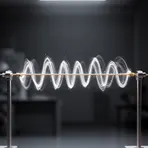
A pattern where some points stay still and others vibrate strongly on a string or in air
Surface Forms
Morphology
The compound directly combines 'standing' (stationary) and 'wave', so a learner who knows both words can plausibly infer it refers to a wave that appears not to travel (i.e., a stationary wave); this compositional logic is common cross-linguistically and aids comprehension. However, the technical details about nodes, amplitudes, and formation by interference are domain-specific and not predictable from the constituents alone, so full understanding requires extra physics knowledge.
Etymology
Standing wave comes from the image of a standing wave: picture a rope tied at both ends where some spots stay still while other parts move up and down. That's why it means 'a wave that stays in one place and does not travel'.