

stationary wave
- noun
- /ˈsteɪʃəˌnɛri weɪv/
- Specialized
- Physicists often study stationary waves to better understand resonance in musical instruments.
Examples
-
A stationary wave can be formed on a string fixed at both ends when vibrated at certain frequencies.
-
The formation of a stationary wave leads to regions of constructive and destructive interference.
-
A stationary wave forms when two waves of the same frequency interfere.
-
In a stationary wave, the nodes do not move.
-
In a guitar string, a stationary wave forms when the string is plucked, creating fixed nodes and maximum amplitude at certain points.
-
The resonance in the tube produced a clear stationary wave pattern, enabling us to observe the nodes and antinodes.
-
When sound waves are trapped in a confined space, they create a stationary wave that vibrates at specific frequencies.
Synonyms
 1
6.9
1
6.9

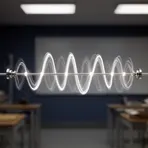
A wave pattern with some points that stay still while parts between them move up and down
Antonyms

- Specialized
A wave that moves through something and carries energy along its path
Surface Forms
Morphology
The label combines 'stationary' (not moving) with 'wave' (a disturbance in a medium), so a B1 learner who knows both words can infer it refers to a wave that does not move or appears fixed in place. Technical details about nodes and interference are specialized, but the core compositional meaning is directly derivable from the constituents.
Etymology
Stationary wave comes from how the wave looks: imagine a rope tied at both ends where some points, called 'nodes', do not move while the parts between them swing up and down. So the word stationary (meaning 'not moving') and wave together explain why it means 'a wave with fixed points' today.