
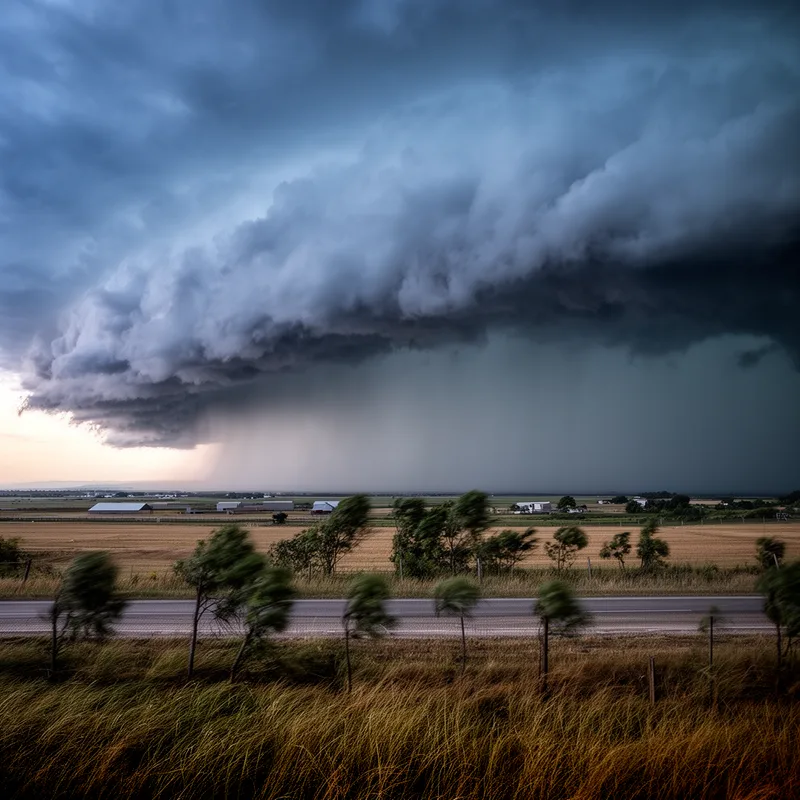
squall line
 1
7.9
1
7.9

- noun
- /skwɔl laɪn/
- Specialized
- C. M. K. Douglas suggested that a squall line traveling up the English Channel, coincident with rain and wind, generated the wave, so it may be referred to as a "meteorological tsunami" (1929).
- the squall line moved
Examples
-
Well, there's a squall line going through here.
-
Arrival of a squall line (some storms sometimes form a front that can be hundreds of kilometers long, called a squall line).
Blog text (20) -
I stood on the porch for a minute and watched the squall line hiss its way across the lake.
Fiction book (1999) -
Arrival of a squall line (some storms sometimes form a front that can be hundreds of kilometers long, called a squall line).
Blog text (20) -
The passage of squall lines over the sea apparently generated three of these events, and two seem to have been far-traveled, long-period waves from mid-North Atlantic atmospheric low-pressure systems.
Academic text (2009) -
The National Weather Service issued a warning as a squall line approached the coast, bringing heavy rain and strong winds.
-
Meteorologists tracked the squall line as it moved rapidly through the region, causing severe thunderstorms.
-
During the storm, we sought shelter from the intense conditions created by the squall line that passed overhead.
Synonyms

A long line of sudden, strong storms that moves along a weather front
How Severe

Surface Forms
Morphology
The meaning is directly derivable from combining 'squall' (a sudden violent gust/storm) with 'line' (a long narrow band): a band or series of squalls/storms. This noun+noun composition follows a transparent, compositional pattern (cross-linguistically common in meteorological terms), so a B1 learner who knows both constituents should be able to infer the MWE meaning.
Etymology
Squall line comes from squall, a sudden strong wind or short storm, and line, meaning a row. Picture a long row of sudden storms moving together, and that's why the phrase means 'a long row of strong storms'.