
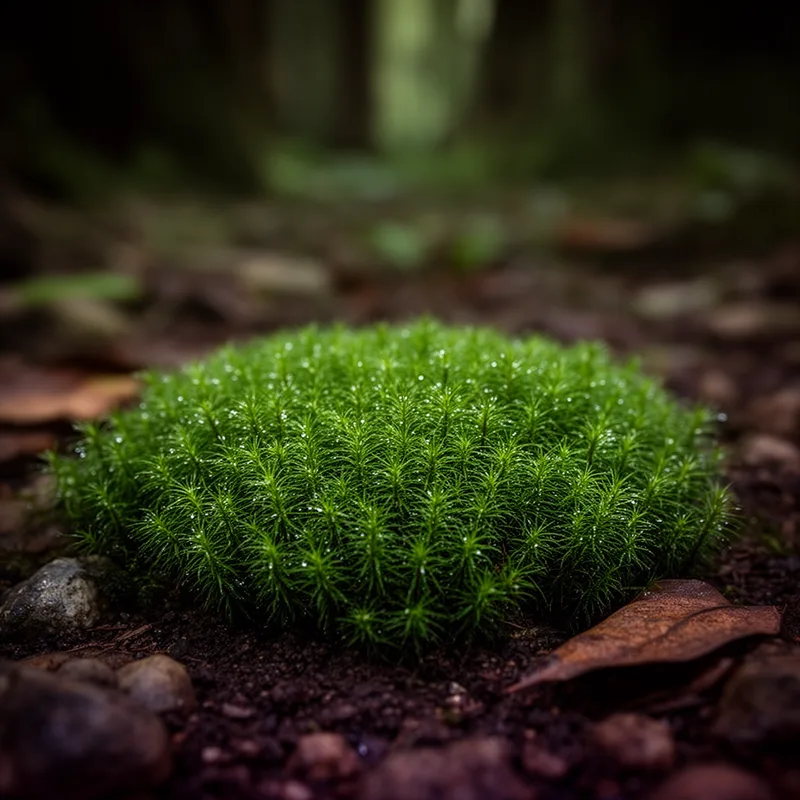
spike moss
- noun
- /spaɪk mɔs/
- Specialized
 :
musgo espigado
:
musgo espigado
- Many gardeners use spike moss as a ground cover because it thrives in moist, shady areas.
Examples
-
Some species of spike moss can survive periods of drought by curling up and appearing lifeless.
-
Botanists are fascinated by the diversity of spike moss in tropical rainforests.
-
The spike moss thrives in damp, shaded areas.
-
Have you seen any spike moss in the forest?
-
In the damp corner of the garden, we discovered some vibrant spike moss thriving among the stones.
-
The spike moss carpeted the forest floor, creating a lush green backdrop for the towering trees.
-
We learned about how spike moss can adapt to various environments during our biology class.
Synonyms

A small evergreen plant that looks like moss and grows close to the ground
A small plant that looks like moss and grows low on the ground
A small plant that looks like moss and grows on the ground
How Small


Surface Forms
Morphology
The compound combines two concrete plant nouns so a learner who knows 'spike' and 'moss' can infer it refers to a moss-like plant with spike-like features; the dictionary sense (a small, moss-like Selaginella) aligns with this compositional reading. Noun compounding of this sort is a transparent and common pattern cross-linguistically, making the meaning predictable for a B1 learner.
Etymology
Spike moss gets its name from how the plant looks. It looks like low, soft moss but has tiny, pointed 'spikes' that hold spores, so people put spike and moss together to name this moss-like plant with small spikes.