
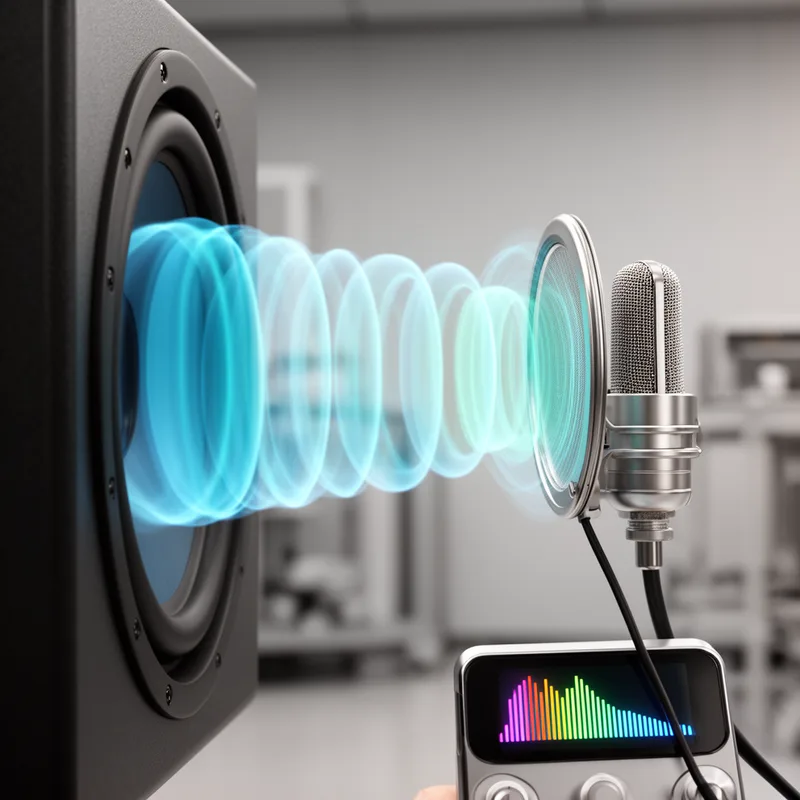
sound pressure
- noun
- /saʊnd ˈprɛʃər/
- Specialized
- OSHA regulations limit permissible noise exposure in the work environment to 0.5 hours per day when exposed to a sound pressure level of 110 dBA.
- sound pressure level
- sound pressure level increase
- total sound pressure
Examples
-
Thus, at low and moderate sound pressure levels, the traveling wave is no longer actively amplified.
Academic text (1998) -
Sound pressure in decibels indicates how much louder one sound is compared to another.
-
And the time domain representation would be how, let's say, the sound pressure as a function of time would change.
-
And if you graph the sound pressure as a function of time, this is what the waveform looks like.
-
The input to the microphone is the free-field sound pressure generated by an ideal loudspeaker.
Academic text (1990) -
The risk from overexposure to sound emanates from a combination of the average sound pressure (decibel level) and the length of time the ear is exposed to the sound.
Academic text (2008) -
The vertical axis shows the sound pressure level (SPL) in decibels, and the horizontal axis shows the Fo, measured in semitones.
Academic text (2011) -
The transducer is a small but powerful design capable of producing sound pressure level equivalents greater than 115 dB when attached to the incus of a fresh temporal bone.
Academic text (1998) -
The sound pressure level in the concert was so high that it hurt my ears.
-
Workers must monitor the sound pressure in the factory to avoid hearing damage.
Synonyms

The pressure of sound at one moment at a point
Antonyms


How High

Surface Forms
Morphology
The term is a straightforward noun-noun compound where the meaning is the pressure associated with or caused by sound; a learner who knows 'sound' and 'pressure' can infer it as pressure related to sound. This compositional logic is common cross-linguistically (e.g., Spanish 'presión sonora', French 'pression acoustique'), so the sense is transparently derivable without specialized exposure.
Etymology
The term sound pressure comes from a simple picture: think of sound as waves that push and pull the air, and pressure as the push on your ear or on a microphone. So sound pressure is the size of that push from a sound, and that's why we measure it to know how 'loud' a sound is.