
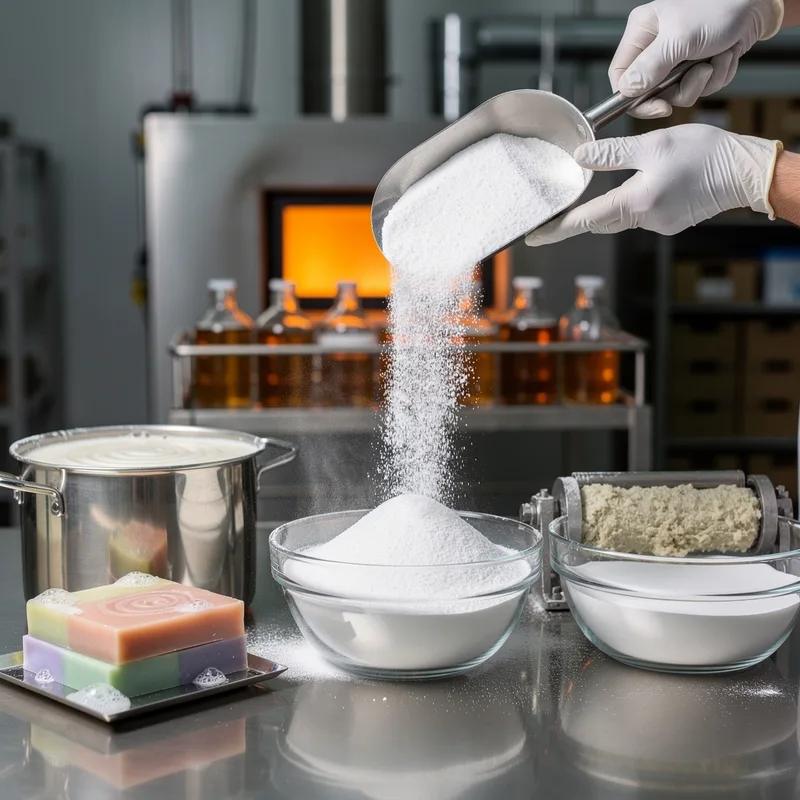
soda ash
 1
6.0
1
6.0

- noun
- /ˈsoʊdə æʃ/
- Specialized
- Soda ash is the common name for sodium carbonate, which is used in the manufacture of glass, ceramics, detergents and soaps.
Loading YouTube…
Watch on YouTubeAnd then from soda ash comes baking soda.
- And then from soda ash comes baking soda.
Examples
-
Sodium carbonate (washing soda, soda ash) is available at pool supply stores in 50 lb bags for just under $30.
Blog text (18) -
My father worked in a trona plant processing soda ash.
Fiction book (1992) -
And then from soda ash comes baking soda.
-
I haven't made any of the soaps yet, but I saw someone trying to find soda, and someone mentioned soda ash.
Blog text (18) -
I had the same problem finding washing soda, aka soda ash and sodium carbonate.
Blog text (18) -
It's apparently also known as soda ash and can be found at art supply stores, JoAnn Fabrics, and other places that sell textile products.
Blog text (18) -
I use the recipe that uses 1 bar of Fels Naptha, borax, and soda ash.
Blog text (18) -
Soda ash is essential in the production of soda ash, helping to lower the melting point of silica.
-
In the soap-making process, soda ash acts as a crucial ingredient for saponification.
-
Manufacturers use soda ash to soften water, making it effective for a variety of cleaning solutions.
Synonyms
 96
2.9
96
2.9
A white chemical that helps make soap, glass, and paper
 15
3.7
15
3.7
A white powder that cleans clothes and removes grease
 1
3.9
1
3.9
A white powder people use for cleaning and for making glass and soap
A white powder that dissolves in water and is used to make soap, glass, and paper
Surface Forms
Morphology
The compound is compositionally built from 'soda' (sodium carbonate) and 'ash' (a powdery residue), so a learner who knows the chemical sense of 'soda' and the sense of 'ash' can infer 'soda ash' = powdered sodium carbonate. This is a technical, literal compound following normal noun + noun formation and is therefore transparently interpretable by learners familiar with the constituent meanings.
Etymology
Soda ash may come from an old practice of burning sea plants and collecting the white ashes left behind. The parts soda (for the salty plants) and ash (for the burned remains) explain the name, and that's why soda ash today means the white powder used to make 'soap', 'glass' and 'paper'.