

social fascism
- noun
- /ˈsoʊʃəl ˈfæʃɪzəm/
- Offensive
- Some political opponents accused the ruling party of social fascism due to its restrictive policies.
Examples
-
The newspaper's editorial warned against creeping social fascism in the regulation of public opinion.
-
Many believe that the rise of social fascism threatens individual freedoms.
-
She argued that mandatory surveillance measures amounted to a soft form of social fascism in society.
-
Critics often label certain government policies as social fascism.
-
Some political opponents accused the ruling party of social fascism due to its restrictive policies.
-
Many believe that the rise of social fascism threatens individual freedoms.
-
The newspaper's editorial warned against creeping social fascism in the regulation of public opinion.
Synonyms

 67
7.9
67
7.9

A political system with one strong leader who limits freedoms and stops opponents
 8
9.1
8
9.1
A political belief that the government controls most public life and the economy
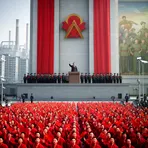
A left-wing political system with strict state control and strong support for the nation

A government policy that limits people's freedoms and weakens democracy
Antonyms
 78
5.8
78
5.8
A political belief that values individual freedom, equal rights, limited government, free markets, and social progress
 3
5.1
3
5.1
A political belief that uses democracy to make the economy fairer and support people's basic needs
How Authoritarian
- Formal
19
9.3
 1
7.6
1
7.6
- Offensive
192
5.0
3
5.1
Surface Forms
Morphology
The phrase is compositionally built from 'social' (relating to society) + 'fascism' (authoritarian ideology), so a learner can infer it denotes a kind or variant of fascism connected to social/political matters. However the term is specialized and historically/politically loaded (often used pejoratively or to imply a blend with socialism), so the precise sense and connotations are not fully predictable for a B1 learner.
Etymology
Social fascism joins social (life in society) and fascism (strict, controlling rule) to paint a simple image: when everyday social rules or public policies are used like a hard tool to force people. People used the term in political fights to call some left policies 'too controlling' or like 'fascism', so today it often means social control that feels harsh or is used as an insult for restrictive left ideas.