
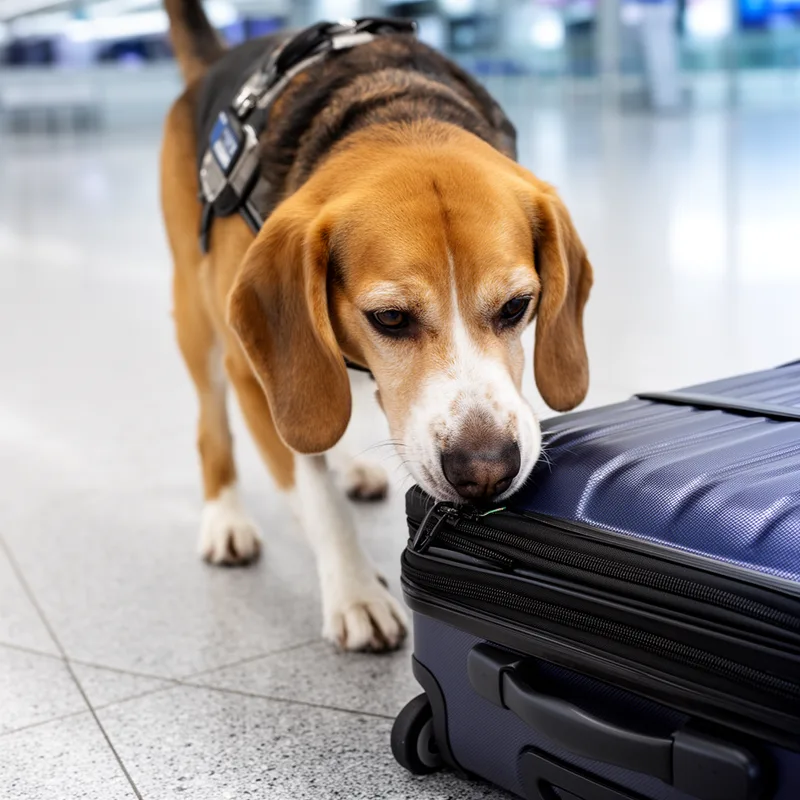
to sniff out
 15
4.0
15
4.0

- phrasal verb
- /snɪf aʊt/
- Informal
- Dogs that have been trained to sniff out infectious diseases.
- the ability to sniff out
Loading YouTube…
Watch on YouTubeSo we were sniffing out what was going to be needed.
- So we were sniffing out what was going to be needed.
- That said, I do still think people can sniff out that she's a chameleon in the way a lot of politicians are.
- I think, I think that especially teenagers, they can sniff out ulterior motives or if you're not being genuine.
- Or you made a very quick decision without really sniffing out if that software platform can do what you want it to do.
- And I'm thinking, hang on, this dog's trained to sniff out all sorts of bits and bobs.
- A recent study found that dogs can sniff out when humans are stressed, building off earlier research that found dogs might be able to tell when a person is happy or fearful.
- Cash Patel, FBI, he is supposed to be in charge of the agency that would sniff out that this was total fraud and charge these people.
Examples
-
A recent study found that dogs can sniff out when humans are stressed, building off earlier research that found dogs might be able to tell when a person is happy or fearful.
-
There are so many watchdogs out there, sniffing out unethical practices among agents.
Blog text (32) -
See if we can sniff out anything suspicious.
-
The readers, I think, will sniff out good books, whatever the subject.
Academic text (2010) -
The U.S. forces that arrived in Haiti in 1994 brought dogs trained to sniff out weapons.
Academic text (1996) -
In traditional Search and Rescue work, trained search dogs sniff out missing people following each person's distinctive scent.
Blog text (17) -
I think, I think that especially teenagers, they can sniff out ulterior motives or if you're not being genuine.
-
The nostrils at the tip of their long beak enable the birds to sniff out soil-dwelling prey.
Academic text (1993) -
The specially trained dog can sniff out drugs that are hidden in the luggage.
-
Investigators used bloodhounds to sniff out evidence at the crime scene.
Synonyms
 ∞
2.6
∞
2.6
To learn or notice something often by chance
 ∞
1.0
∞
1.0
To notice a scent with your nose
 763
3.2
763
3.2
Find something that is hard to notice
 70
5.8
70
5.8
To notice something that is hard to see or hear
 64
3.0
64
3.0
Notice a sound or sight among other things
 40
3.1
40
3.1
To notice something suddenly or after looking for it
 11
4.7
11
4.7
Smell something briefly, often a strong scent
 5
3.5
5
3.5
To use the sense of smell to find something, often by animals
 4
5.1
4
5.1
To notice a small smell of something for a short time
 3
5.0
3
5.0
To find something by sniffing around
 3
7.9
3
7.9
To smell something quickly to see what it is
 2
5.1
2
5.1
Find something hidden by noticing small signs


 1
6.9
1
6.9
Find something after careful searching
To find something by smell or by careful searching
Antonyms

How Thorough

Surface Forms
Morphology
The sense 'to discover or detect' is motivated by the literal meanings of 'sniff' (to smell/search with the nose) and 'out' (to find or bring to light), so the connection is partly transparent. However, the extension to abstract or non-olfactory detection (e.g., investigating, uncovering facts) is metaphorical and may not be fully predictable to a B1 learner without prior exposure.
Etymology
Sniff out comes from the image of a dog using its nose to sniff and follow a smell out until it finds something hidden. That's why today it means 'to find' or 'discover' something by searching carefully.