
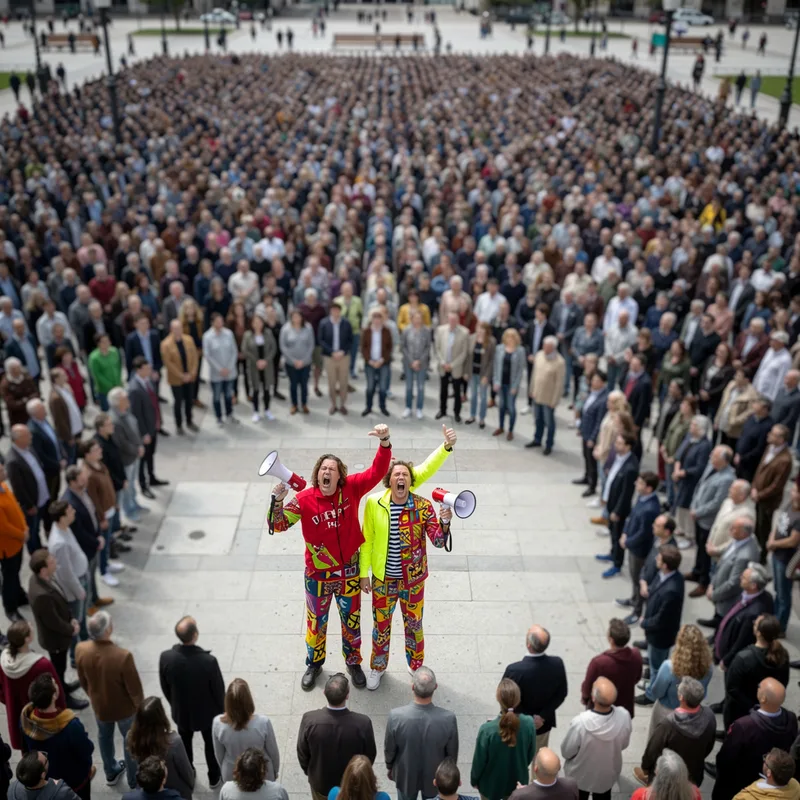
silent majority
 7
5.6
7
5.6

- noun
- /ˈsaɪlənt məˈdʒɔrɪti/
- Literature
- No longer will the "silent majority" of this country be silent anymore.
Loading YouTube…
Watch on YouTubeAnd then they say, well, now we've heard from the silent majority.
- And then they say, well, now we've heard from the silent majority.
- They are the quintessence of the silent majority.
- And and you see this complete metamorphosis of all of these people that say that they're, you know, the silent majority.
Examples
-
I'm one of the silent majority.
-
Richard Nixon had his "silent majority" that he felt supported his views.
Blog text (1) -
So tonight, to you, the great silent majority...
-
I did speak of a silent majority above.
Blog text (26) -
The silent majority had been there for some time, all waiting for "someone" to do something.
Blog text (3) -
Nixon used to say he represented the silent majority.
Blog text (23) -
The administrator could honestly argue that these vocal protestors do not speak for the silent majority.
Academic text (1993) -
The population at large, the silent majority, does not support us or help us by informing the troops about IEDs.
Blog text (3) -
The silent majority of my country, men and women, resisted the fanaticism and the hatred.
Academic text (1993) -
Many politicians claim that the silent majority has been overlooked in recent debates.
Synonyms
 ∞
2.1
∞
2.1
More than half of the people or things in a group
How Influential

Surface Forms
Morphology
The phrase combines 'silent' (not speaking) and 'majority' (the larger portion), so a B1 learner who knows the words can readily infer it refers to the large group who do not publicly express their opinions. While there is a pragmatic political nuance about their views relative to vocal minorities, the basic meaning is directly compositional and is attested across many languages.
Etymology
The phrase silent majority was made famous by a U.S. president in 1969 who used it to mean the large group of people who stayed quiet while a smaller group spoke loudly. Picture a room where a few people shout and the much bigger group sits silently; the words silent and majority explain why it means 'the large group who do not speak up'.