
sickle cell
 10
4.3
10
4.3

- noun
- /ˈsɪkəl sɛl/
- Specialized
- Patients with sickle cell anemia and its variants were considered for inclusion.
- sickle cell anemia
- sickle cell disease
- sickle cell trait
Examples
-
Catherine has sickle-cell anemia.
-
Some populations in Africa have high frequencies of the sickle cell gene.
Academic text (1992) -
The sickle cells must be blocking the blood flow again.
-
There's a disease of the blood called sickle-cell anemia.
-
He's got sickle cell anemia.
-
Inherited hemoglobin defects include sickle cell anemia and thalassemia.
Academic text (2003) -
Several genetically based diseases can now be identified, such as Down syndrome, Tay-Sachs disease, sickle cell anemia, cystic fibrosis, and Huntington's disease.
Academic text (2007) -
Some of the most known and publicized inheritable conditions are Tay-Sachs disease, muscular dystrophy, sickle cell disease, and cystic fibrosis.
Academic text (2005) -
A blood test can confirm the presence of sickle cell disease in patients.
-
One child out of four will inherit sickle cell disease if both parents carry the trait.
Surface Forms
Morphology
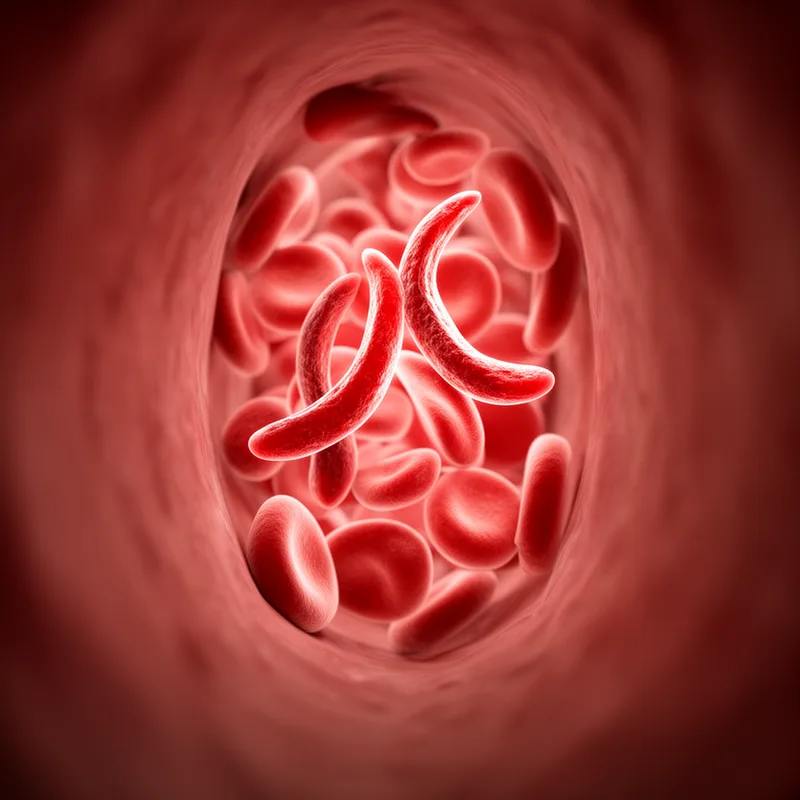
The phrase is compositionally transparent: 'sickle' denotes a curved, crescent-like shape and 'cell' is a microscopic unit, so a B1 learner who knows both words can infer a cell shaped like a sickle. Although used in a medical context, the shape-based naming is straightforward and cross-linguistically common, so the meaning is predictable from the constituents.
Etymology
Sickle cell comes from the curved farming tool called a sickle, because some red cells bend into the same curved shape. That's why doctors call these bent blood cells 'sickle cells' and why the disease uses the same name.