
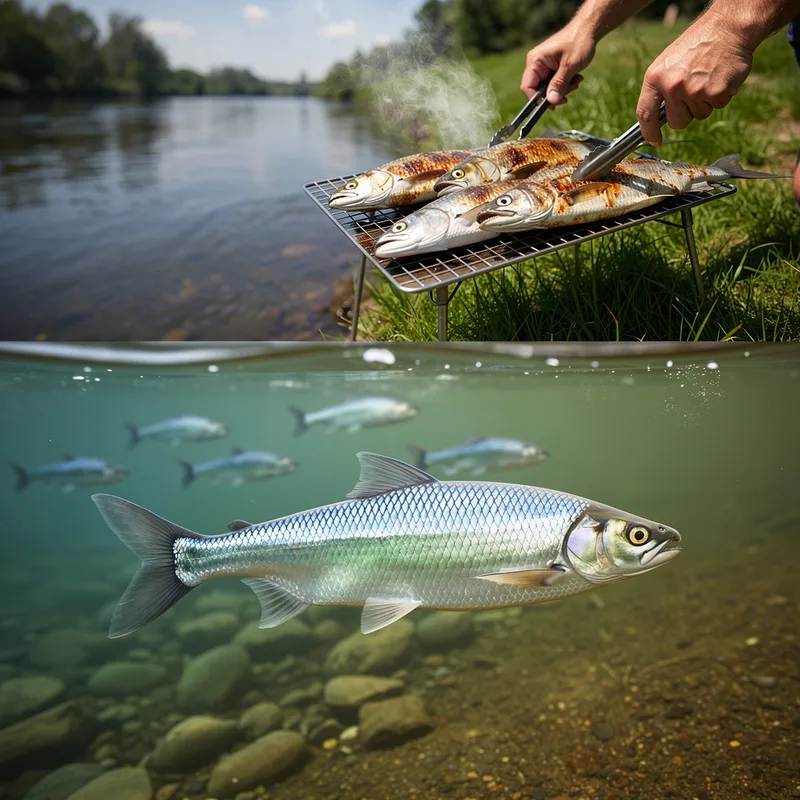
shad
 5
8.4
5
8.4

- noun
- /ʃæd/
- The chef prepared a delicious dish using shad, a fish popular in coastal areas.
- catch shad
- shad nets
- American shad
Examples
-
And the shad are running.
Fiction book (1994) -
Stake gill nets were used to catch shad from February to early May, and the main shad run lasted about 5 weeks.
Academic text (1990) -
Indeed, large quantities of shad were caught in a season lasting about 5 weeks.
Academic text (1990) -
In spring, they were used to catch, first, shad and then menhaden.
Academic text (1990) -
In March and April, they caught mostly alewives and shad.
Academic text (1990) -
In the 1890s, the annual catch of shad in Raritan Bay was about 50,000 fish.
Academic text (1990) -
The remnant American shad run on the Delaware River, once the largest shad run in the country, uses spawning areas near the confluence of the East and West Branches, not too far below the dams.
Academic text (2004) -
Several of these, notably the blue crab, spend parts of their life cycles in different salinities; others, such as the river shad, used the bay and its tributaries as part of their migratory journeys until they were depleted by overfishing, pollution, destruction of habitat, and dam construction.
Academic text (2005) -
The usual catch was 8-10 bushels of fish, including alewives, bluefish, flounder, menhaden, mullet, shad, striped bass, and weakfish.
Academic text (1990) -
Fishermen often target shad during their migration to freshwater rivers to spawn.
Synonyms

A fish like a small herring that lives in European rivers and seas and swims upstream to lay eggs

A large European fish that moves from the sea into rivers to lay eggs

A fish that lives in Europe and swims from the sea into rivers to lay eggs

A group of fish like shads that live in northern rivers and seas
A group of fish called shads in the herring family

A fish from the Atlantic coast of North America that people eat

A fish that swims into Mississippi River streams to lay eggs
A fish like a small herring that swims into streams connected to the Mississippi River to lay eggs

A small silvery fish that lives along the western Atlantic coast from Nova Scotia to Brazil
Compounds

- Specialized
A small silvery fish that lives along the western Atlantic coast from Nova Scotia to Brazil

A common wild plant with a circle of leaves at the base, small flowers, and long seed cases
Surface Forms
Etymology
The word shad is a very old English name for this herring-like fish. A helpful way to remember it is to think of shade ('shadow') for the fish's dark back, so shad names the small, edible fish that moves from the sea into rivers to lay eggs.