
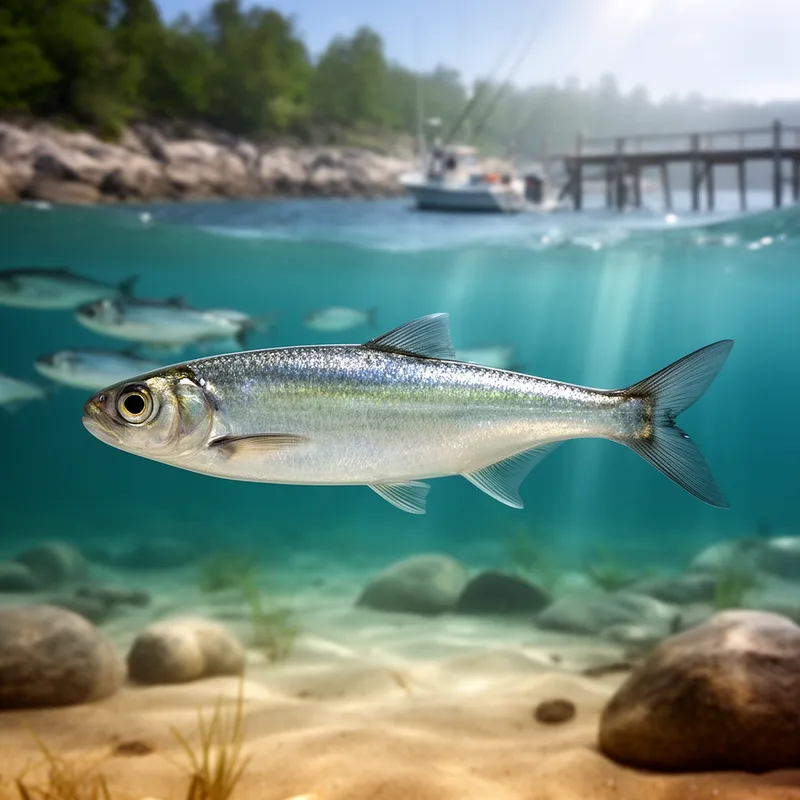
mackerel shad
- noun
- Specialized
- The mackerel shad is often seen in coastal waters during the summer months.
Examples
-
Fishermen in the region rely on mackerel shad as a source of bait and food.
-
A school of mackerel shad darted through the shallow cove.
-
The mackerel shad swims gracefully in the ocean.
-
Many fishermen catch mackerel shad during the summer.
-
Fishermen in the region rely on mackerel shad as a source of bait and food.
-
A school of mackerel shad darted through the shallow cove.
-
The mackerel shad is often seen in coastal waters during the summer months.
Synonyms
A small silvery mackerel-like fish found in the western Atlantic from Nova Scotia to Brazil

A small silvery sea fish often eaten or used as bait
How Big


Surface Forms
Morphology
Both constituent words are names of fish, so the noun–noun compound transparently denotes a type of fish composed from those meanings; a B1 learner who knows 'mackerel' and 'shad' will infer it refers to a fish (likely a small silvery species) even if they don’t know exact taxonomic details. This kind of compositional species name follows regular English compounding patterns and is cross-linguistically common, making its basic meaning predictable from the parts.
Etymology
Mackerel shad: The name mackerel shad comes from the fish's look and how people used it. It is a small, silvery fish that looks a little like both a mackerel and a shad, and fishermen often used it as 'bait', so the name came to mean this particular coastal fish.