

seaside scrub oak
- noun
- Specialized
- In the southeastern United States, the seaside scrub oak is commonly found in sandy coastal areas.
Examples
-
The seaside scrub oak thrives in the sandy soils along the Atlantic coast.
-
Dense thickets of seaside scrub oak make hiking through these dunes quite difficult.
-
Conservationists are studying the unique ecosystem created by seaside scrub oak habitats.
-
Look at that seaside scrub oak growing by the beach!
-
The seaside scrub oak thrives in sandy soils.
-
The seaside scrub oak forms dense thickets that provide shelter for many coastal birds.
-
Visitors often enjoy the shade provided by the seaside scrub oak while walking along the beach.
Synonyms

A small evergreen tree or shrub that grows in dense sandy coastal thickets
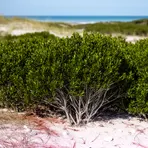
A small evergreen shrub or tree that grows in dense groups on sandy coasts in the southeastern United States
Surface Forms
Morphology
The phrase is a straightforward compound describing an oak (oak) that grows in scrub habitat by the seaside (seaside + scrub + oak), so the referent — a small coastal shrub-like oak — can be composed from the constituents. This is a literal, descriptive botanical label rather than an idiom or metaphor, and the noun-noun compounding pattern is cross-linguistically common, making it understandable to a B1 learner who knows the component words.
Etymology
Seaside scrub oak paints a simple picture: an oak that grows as low scrub beside the seaside. So the name means 'a small, always-green oak shrub' that forms thick groups in sandy coastal areas.

