

myrtle oak
- noun
- /ˈmɜːrtəl oʊk/
- US
- The myrtle oak thrives in sandy coastal soils.
Examples
-
Myrtle oak is well-adapted to the dry, nutrient-poor soils found in its native range.
-
The dense growth of myrtle oak provides excellent shelter for wildlife along the Florida coast.
-
We hiked through a thicket of myrtle oak on the sandy ridge.
-
Many myrtle oaks grow in the Florida wetlands.
-
The myrtle oak can be found thriving in the sandy coastal areas of Florida.
-
In the nature reserve, clusters of myrtle oak create dense thickets, providing habitat for wildlife.
-
Hikers often enjoy the shade of myrtle oaks while trekking through the southeastern forests.
Synonyms
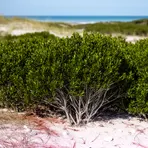
A small evergreen shrub or tree that grows in dense groups on sandy coasts in the southeastern United States

A small evergreen shrub or tree that grows in sandy coastal areas and forms dense thickets
Surface Forms
Morphology
This is a transparent noun–noun compound where 'oak' is the head (a type of tree) and 'myrtle' qualifies it, so a learner who knows both words can infer it names a kind of oak with myrtle-like qualities or association. Such taxonomic/compound naming patterns (e.g. 'willow oak', 'peach tree') are compositional and cross-linguistically common, making the meaning predictable to a B1 learner.
Etymology
Myrtle oak gets its name from the tree's leaves: they look like the leaves of the myrtle plant, so people combined myrtle (for the leaf shape) and oak (the tree). That's why the name refers to a small evergreen oak that often grows in thick bushes.

