

sea urchin
 8
4.2
8
4.2

- noun
- /si ˈɜrʧɪn/
- The ocean floor was dotted with sea urchins, their spiny shells blending with the rocks.
- red sea urchin
- California sea urchin
- sea urchin fishery
Loading YouTube…
Watch on YouTubeAnd it's a relation of the sea urchins and the starfishes.
- And it's a relation of the sea urchins and the starfishes.
- So you've seen them lying on their back with this, with the rocks eating the sea urchins.
- It's like it's like a a sea urchin, but on the street.
- Yeah, bro, dude, like a little sea urchin, dude, it was so bad.
Examples
-
Twenty years after the sea urchin disease burnt itself out, the urchin populations are only slowly recovering.
Academic text (2008) -
Sea otter predation of sea urchins has led to increased kelp production (Watson and Estes 2011).
Academic text (2013) -
I would never eat a sea urchin.
-
But there was one bit where there were loads of sea urchins on the ground.
-
The little white chunks are sea urchin.
-
This is our sea urchin, with an emulsion of sea weed.
-
It's sea urchin wrapped in seaweed, or nori.
-
There are nearshore areas where sea urchins are the dominant benthic organism.
Academic text (1997) -
We watched the sea urchins wave their spiny selves back and forth in a tidal pool.
Fiction book (1998) -
His spaghetti arrived, topped with sea urchin and shredded seaweed.
Fiction book (1996)
Synonyms
 14
4.9
14
4.9
A small sea animal with a round spiny shell on the ocean floor
 1
5.6
1
5.6
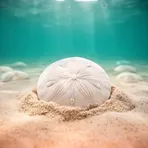
A flat round sea animal with a hard shell that lives on sandy sea floors
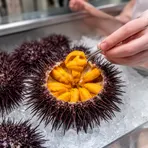
A small sea animal with spikes whose soft parts people eat, like uni
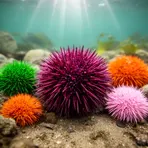
An animal that lives in the sea with a spiny shell, like a sea urchin

A sea animal with a heart-shaped body and a spiny shell
Surface Forms
Morphology
The meaning is directly and compositionally derived from 'sea' (saltwater) + 'urchin' (a spiny marine animal): it denotes an urchin that lives in the sea. This straightforward noun–noun modifier pattern is cross-linguistically common and would be immediately understandable to a B1 learner who knows both constituents.
Etymology
Sea urchin: The name comes from the animal's look — its round body and sharp spines made people think of a 'hedgehog' in the sea. So they used sea (where it lives) and urchin (an old word for 'hedgehog'), and the name came to mean the small, spiny sea animal.