

heart urchin
- noun
- /hɑrt ˈɜrʧɪn/
- Whereas most heart urchins live in sand, through which oxygenated waters percolate down to the buried animals, some species of Schizaster and Brissopsis have adapted to living in muddy sediments.
Examples
-
To live in this environment, heart urchins have evolved a range of other specialized characteristics.
Academic text (1992) -
The heart urchin is a unique marine creature known for its heart-shaped body and spiny shell.
-
During the Cenozoic, a number of heart urchins continued this trend.
Academic text (1992) -
From that time on, species of spiny heart urchins multiplied.
Academic text (1992) -
The link between the evolution of spiny heart urchins and cassids is strengthened by the past distribution of the two groups.
Academic text (1992) -
They attack urchins that do not burrow, as well as heart urchins completely hidden in the sediment.
Academic text (1992) -
PHOTOS: To avoid predators, the purple heart urchin below can use its small, hairlike spines to burrow into the bottom sediments.
Academic text (1992) -
I focused my attention on a single urchin lineage: three species of extinct heart urchins in the genus Lovenia.
Academic text (1992) -
One of the classic examples of evolution in the fossil record is provided by the heart urchin Micraster, a resident of northern European seas between 90 and 80 million years ago, during the Cretaceous period.
Academic text (1992) -
With the arrival of the cassids in the Eocene, 50 million years ago, the heart urchins were no longer safe in their snug little burrows, for these snails could also burrow.
Academic text (1992)
Synonyms

 14
4.9
14
4.9

A small sea animal with a round spiny shell on the ocean floor
 8
4.2
8
4.2
A small round sea animal with sharp spines that lives on rocks
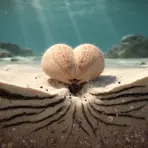
A heart-shaped sea urchin that burrows into the sea floor to feed
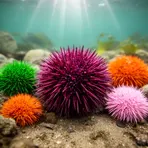
An animal that lives in the sea with a spiny shell, like a sea urchin
Surface Forms
Morphology
The meaning is directly and transparently derived from combining 'heart' (heart-shaped) with 'urchin' (a small spiny marine animal); it denotes an urchin with a heart-shaped body. This straightforward noun–noun compounding follows common compositional patterns found across languages, so a B1 learner who knows both constituents should be able to infer the meaning.
Etymology
Heart urchin gets its name because the animal's hard shell looks like a heart and it is an urchin with spines. So the name means 'a sea urchin with a heart-shaped body'.