
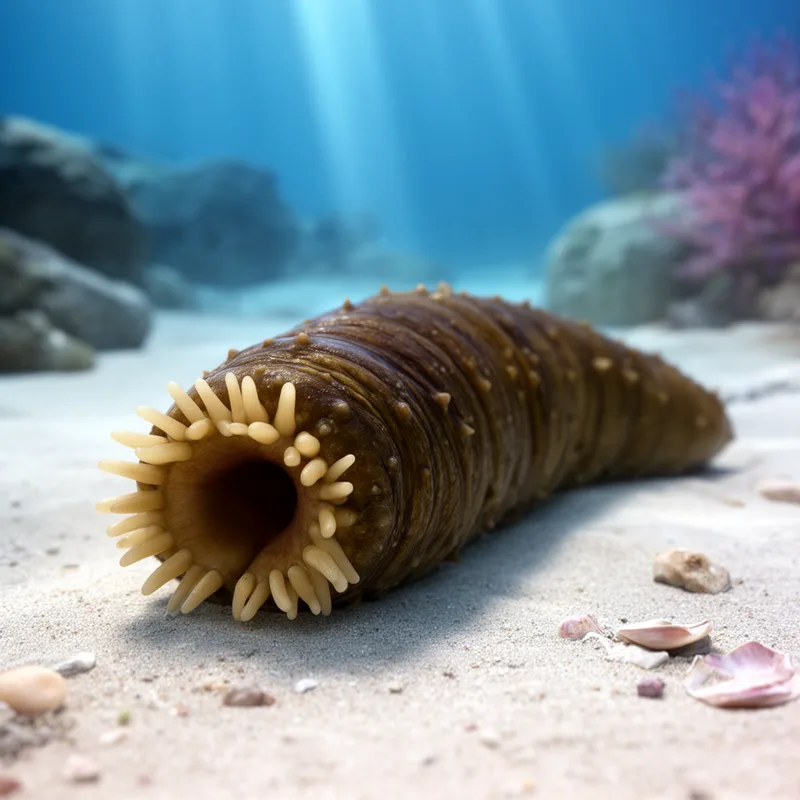
sea cucumber
 4
4.8
4
4.8

- noun
- /siː ˈkjuːm.bər/
- There are about 1,400 living species of sea cucumber in a variety of forms.
- sea cucumber fishery
- sea cucumber species
- sea cucumber landing
Examples
-
In many coastal regions, people often harvest sea cucumbers as a delicacy.
-
I sent him to look for sea cucumbers.
-
I had a bit of a weird experience with the sea cucumber.
-
I always wanted to try a sea cucumber.
-
At present, 66 species of sea cucumbers are commercially exploited.
Academic text (2015) -
Some species of sea cucumbers produce toxins that have medicinal value.
Academic text (2015) -
Sea cucumbers are considered a culinary delicacy and a traditional cure for many illnesses in many Asian countries.
Academic text (2015) -
The Holothuroidea, or sea cucumbers, are an abundant and diverse group of worm-like and usually soft-bodied echinoderms.
Academic text (2015) -
The underwater explorer observed a sea cucumber crawling along the ocean floor.
-
Divers discovered a rare species of sea cucumber during their marine research.
Synonyms
 2
9.9
2
9.9
A sea animal like a starfish or sea urchin with tube feet and five similar sections
 1
1.0
1
1.0
A living thing that lives in the sea like a fish or whale

A sea animal with a soft, long body and tentacles near its mouth

A deep-sea animal that looks like a fat sea cucumber and crawls on the ocean floor
Surface Forms
Morphology
sea + cucumber
The meaning is directly and compositionally derived from 'sea' (marine) + 'cucumber' (the vegetable): it denotes a sea-dwelling organism that resembles a cucumber in shape/appearance. This kind of descriptive noun–noun compounding is common across languages (e.g., French 'concombre de mer', Spanish 'pepino de mar') and follows a transparent naming pattern that a B1 learner who knows the constituents can infer.
Etymology
Sea cucumber was named because this slow, soft animal looks like a long garden cucumber that lives in the sea, often lying on the ocean floor. That clear picture helps explain why the name means 'a sea animal with a long, soft body'.