
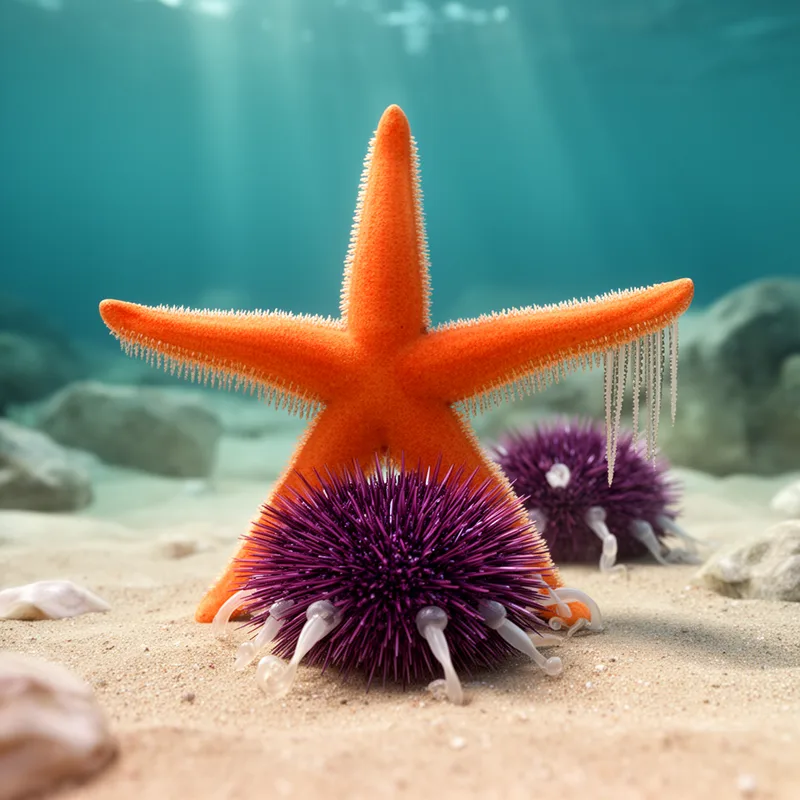
echinoderm
 2
9.9
2
9.9

- noun
- /ˌɛkɪˈnɒdɜrm/
- Specialized
- He became a world authority on echinoderms, and in 1964, he was offered and accepted a post as Curator in Invertebrate Zoology at the Museum of Comparative Zoology at Harvard University.
Examples
-
The starfish, a well-known echinoderm, has the ability to regenerate lost arms.
-
This change has been linked to increases in biomass of benthic echinoderms, which in turn may be related to eutrophication or fishing disturbance (Duineveld et al. 1987).
Academic text (2000) -
Crinoids, a type of echinoderm.
-
Echinoderm fisheries are generally small in scale.
Academic text (1993) -
Echinoderm: The starfish, with spiny skin, is a common echinoderm found at the shore.
Academic text (2015) -
Clockwise from top, an onychophoran, a polychaete, an ascidian, and an echinoderm.
Academic text (1997) -
The Holothuroidea, or sea cucumbers, are an abundant and diverse group of worm-like and usually soft-bodied echinoderms.
Academic text (2015) -
"Its abundant sponges and echinoderms are more typical of the filter feeder-dominated fauna of seamounts."
Academic text (2004) -
Accessory organisms include brachiopods, echinoderms, ostracods, pelmatozoans, bryozoans, and conodonts.
Blog text (19) -
It may include fish, crustaceans, mollusks, echinoderms, sponges, stingrays, sharks, and sea turtles.
Academic text (1999)
Surface Forms
Morphology
Etymology
Echinoderm comes from Greek parts echino- meaning 'spiny' (like a hedgehog) and -derm meaning 'skin'. So an echinoderm is an animal with 'spiny skin', which fits creatures like starfish and sea urchins.