
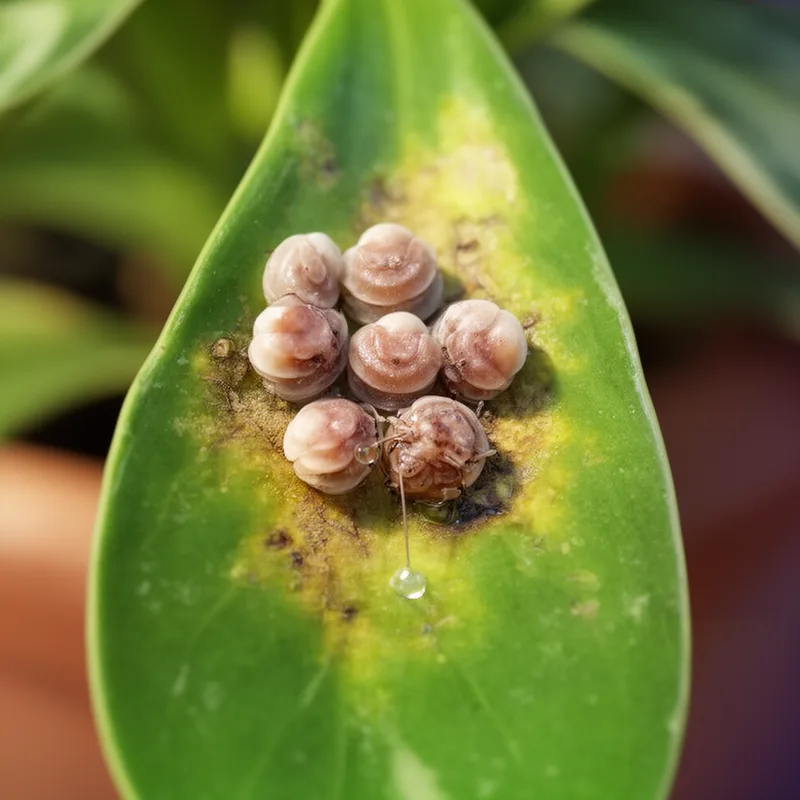
scale insect


 1
7.3
1
7.3
- noun
- /skeɪl ˈɪn.sɛkt/
- Scale insects can damage plants by sucking their sap, leading to wilting and stunted growth.
- mealybugs and scale insects
- scale insects and aphids
- armored scale insect
Loading YouTube…
Watch on YouTubeAnd there are many species of ants that live off of the excretions of the scale insects, which are politely called honeydew.
- And there are many species of ants that live off of the excretions of the scale insects, which are politely called honeydew.
- Now, if it's just a couple of scale insects here and there, you can try picking them off, squishing them, destroying them.
Examples
-
One of the known dyes of the ancient world was the scarlet dye produced from coccoid scale insects (Forbes 1964, Koren 1993).
Academic text (2005) -
Aphids, adelgids, and scale insects in the suborder Sternorrhyncha accounted for 69% of the Hemiptera and 28.6% of all species on the complete list.
Academic text (2010) -
Now, if it's just a couple of scale insects here and there, you can try picking them off, squishing them, destroying them.
-
We present evidence based on chemical analysis that identifies the scarlet dye produced by the scale insect.
Academic text (2005) -
And there are many species of ants that live off of the excretions of the scale insects, which are politely called honeydew.
-
Shipments of gardenias to the U.S. mainland have been banned since 1948 because of fears that they carry coffee green scale insects.
Academic text (2000) -
Wool dyed with the scale insect Kermes echinatus.
Academic text (2005) -
That is, the ants care for hemipterous insects, such as scale insects and aphids, which produce sugary food in exchange for protection and other favors.
Academic text (2010) -
It is important to regularly check for scale insects on houseplants to prevent infestations.
-
The gardener treated the scale insects on the leaves with a special insecticidal soap.
Synonyms
 1
6.4
1
6.4
A small insect with a white, cottony covering that eats and harms plants

Small insects that live on plants and feed on their sap
How Armored

Surface Forms
Morphology
The compound is directly compositionally interpretable: 'scale' (a covering or plate) + 'insect' (small arthropod) yields an insect characterized by a scale-like protective covering. While the precise biological detail (sap-sucking, waxy secretion) is specialist knowledge, a B1 learner who knows both words will understand the basic meaning, and many languages form similar compounds, supporting transparency.
Etymology
Scale insect is named for the hard, flat scale-like covers that sit on these tiny insects and make them look like small bumps on leaves and stems. Because they 'suck' plant 'sap' and hide under this protective cover, scale insect now means those small, sap-sucking pests.