

salt lick
 1
6.5
1
6.5

- noun
- /sɔlt lɪk/
 :
salero
:
salero
- For a hundred feet ahead of him was a flat green meadow where the neighbors' horses, Simon and Lennie, sometimes grazed, and over to his right was a salt lick, a pinkish-colored, one-foot-high block with a single depression in the center.
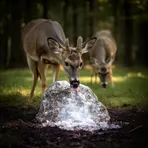
- deer at a salt lick
Examples
-
That's why the animals that one sees coming to salt licks are deer and antelope, not lions and tigers.
Academic text (1991) -
During the summer, the wildlife photographer set up her camera near a salt lick to capture images of the visiting deer.
-
Near the door, I have hung a salt lick on a piece of wire.
Fiction book (1999) -
They sell salt licks for farm animals with cats and dogs all around.
Blog text (7) -
Okapis are not seen in groups with other large forest mammals at salt licks.
Academic text (1992) -
Bears often visit a salt lick in the early morning to obtain essential minerals from the rocks.
-
Farmers sometimes create a salt lick in the pasture to help improve the health of their livestock.
Synonyms
 8
8.1
8
8.1
A natural place where animals lick salt or minerals
Surface Forms
Morphology
The meaning 'a place where animals lick salt' is directly and compositionally built from 'salt' + 'lick'; a B1 learner who knows 'salt' and the verb 'lick' can readily infer a spot or deposit animals lick to obtain salt. This noun–noun place-formation is a common descriptive pattern across languages, so the expression is transparent.
Etymology
Salt lick comes from a simple picture: animals would go to a spot with natural salt and lick the ground or rocks to get needed minerals. So, salt lick means 'a place where animals regularly lick salt to get minerals'.