
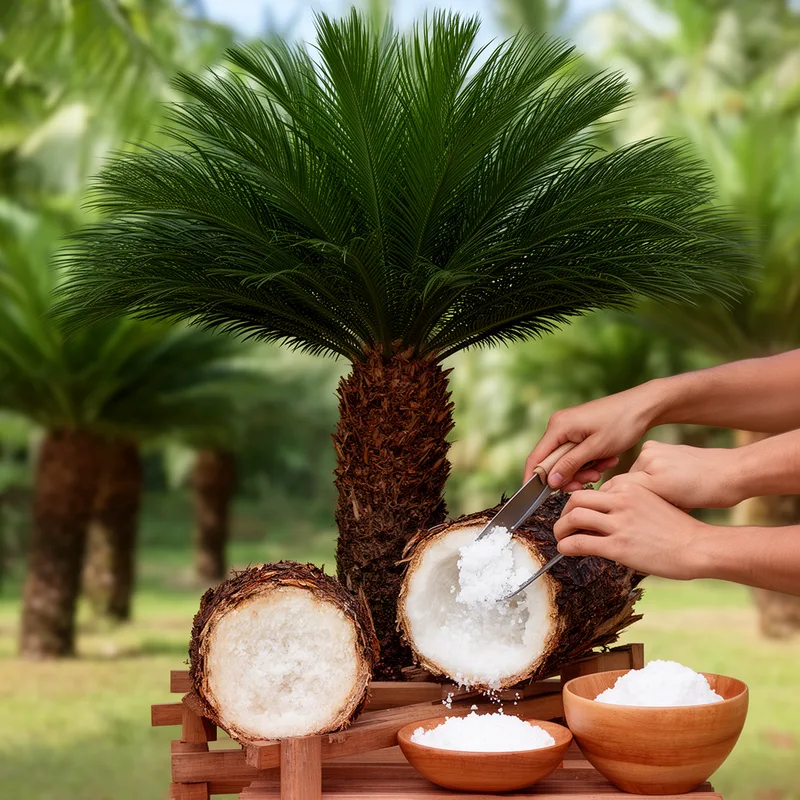
sago palm
- noun
- /ˈseɪɡoʊ pɑːlm/
- In tropical regions, the sago palm provides essential nutrition as its trunk yields a valuable starchy substance.
Examples
-
Farmers cultivate sago palms primarily for the sago they produce, which is a key ingredient in their traditional dishes.
-
They might also manage wild food resources, such as sago palms and reindeer, for future use, and males could use women as assets to obtain goods in exchange with others for marriage, both examples of delayed return.
Academic text (1991) -
The sago palm is known for its edible starchy pith, which is a staple food in many cultures.
Synonyms

A palm tree whose trunk gives a starchy food used for cooking

A Malaysian palm tree whose soft trunk produces sago used as a food starch and to make cloth
A small plant like a palm from Japan that gives starch from its trunk
Surface Forms
Morphology
The compound 'sago palm' is directly compositional: it combines 'sago' (the starchy product) with 'palm' (a tropical tree), so a learner who knows both words can infer it denotes a palm associated with or yielding sago. This noun–noun compounding pattern is common and cross-linguistically straightforward, so the meaning is predictable rather than idiomatic.
Etymology
Sago palm likely comes from the word sago, the name for the white 'starch' made from the soft inside of the plant, and palm, the type of tree it grew on. The simple image of a tree that gives edible sago explains why sago palm means a plant whose trunk yields that starchy food.

