

rutabaga plant
- noun
- /ˈruːtəˌbeɪɡə/
- Specialized
- The rutabaga plant produces a bulbous root that is delicious in soups and stews.
Examples
-
The rutabaga plant is often harvested in autumn for its sweet, yellow root.
-
Farmers rotate cabbage, rutabaga plant, and broccoli to prevent disease in the soil.
-
He carefully weeded his garden, making sure the rutabaga plant had enough space to grow.
-
The rutabaga plant thrives in cold climates.
-
Many farmers grow rutabaga plants for their rich flavor.
-
He carefully tended to his garden, ensuring the rutabaga plant received ample sunlight and water.
-
During the winter, the rutabaga plant remains in the ground, where it can be harvested as needed.
Synonyms

 9
7.2
9
7.2

A large round root vegetable like a turnip with yellow flesh eaten as food
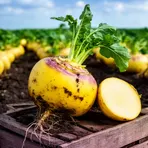
A root vegetable with a large yellow bulb that you can eat, called rutabaga or swede

A large round yellow root vegetable also called rutabaga

A large round root vegetable with yellowish inside used for cooking
Surface Forms
Morphology
The phrase is a straightforward nominal compound where the headword 'rutabaga' (a type of root vegetable) is specified as a 'plant', so the meaning is directly the plant that produces rutabagas. This compositional pattern (noun + plant = the plant of that type) is transparent and cross-linguistically common, so a B1 learner who knows both constituents would readily understand it.
Etymology
Rutabaga plant refers to a garden plant that grows a large, round rutabaga, a yellow 'root vegetable' under the soil. Imagine pulling up that heavy, round root from the earth— that's why the name means the plant that produces the 'edible' root.