
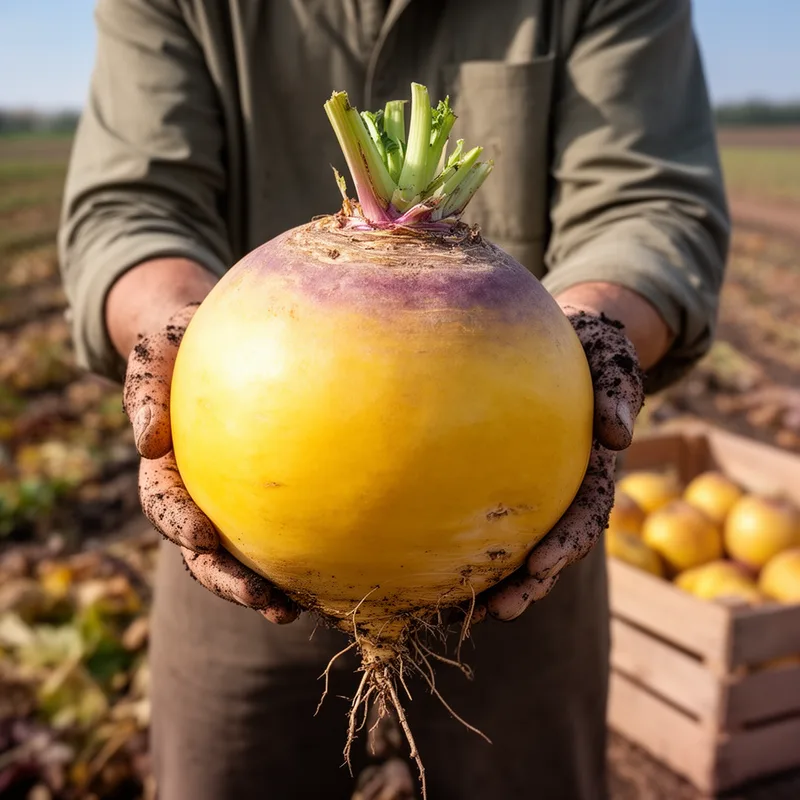
Swedish turnip
- noun
- /ˈswidɪʃ ˈtɜrnɪp/
- US
- In Britain, Swedish turnip is often served mashed with butter as a side dish.
Examples
-
We used Swedish turnip in the stew for a sweet, earthy flavor.
-
I bought a Swedish turnip at the market.
-
Farmers harvested a large crop of Swedish turnip this year.
-
My grandmother used to grow Swedish turnips in her garden.
-
In Britain, Swedish turnip is often served mashed with butter as a side dish.
-
We used Swedish turnip in the stew for a sweet, earthy flavor.
-
Farmers harvested a large crop of Swedish turnip this year.
Synonyms

 9
7.2
9
7.2

A large round root vegetable like a turnip with yellow flesh eaten as food

A large round root vegetable with yellowish inside used for cooking
A root vegetable with a large yellow bulb that you can eat, called rutabaga or swede

A plant with a large yellow root that you eat
A large yellow root vegetable people eat cooked or mashed
Surface Forms
Morphology
The phrase 'Swedish turnip' is a transparent adjective + noun combination: it denotes a type or variety of turnip associated with Sweden (i.e., rutabaga/swede), so the overall meaning is directly inferable from 'Swedish' and 'turnip'. This compositional pattern is common cross-linguistically, so a B1 learner who knows both constituents would readily understand it.
Etymology
Swedish turnip may come from the vegetable being brought to Britain from Sweden long ago, so people called it a Swedish kind of turnip. It is also called 'rutabaga' or 'swede' from a Swedish word meaning 'root cabbage', which helps you remember it is a large, yellow root vegetable.