

rose bug


 1
7.3
1
7.3
- noun
- /roʊz bʌg/
- US
- The larvae of the rose bug can cause serious damage to the roots of fruit trees.
Examples
-
The garden was infested with rose bugs that were eating the leaves off the rose bushes.
-
Many gardeners handpick rose bugs from their plants to protect their flowers.
-
The rose bug is a common pest for gardeners.
-
In spring, rose bugs can be found on many rose bushes.
-
The garden was infested with rose bugs that damaged the petals of the flowers.
-
To protect her plants, she used insecticide to eliminate the rose bugs in her rose bushes.
-
After noticing the rose bugs, he quickly researched how to treat them before they harmed his apple trees.
Synonyms

A North American beetle whose young eat roots and adults eat leaves and flowers of garden plants
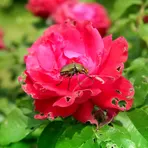
A small insect that eats the leaves and flowers of roses
Surface Forms
Morphology
The noun compound is directly compositional: 'rose' names the plant and 'bug' names an insect, so a learner who knows both words can infer it denotes an insect associated with roses (likely a pest). There is no idiomatic or metaphorical shift and the modifier+noun pattern is common cross‑linguistically, making the meaning immediately accessible to a B1 learner.
Etymology
Rose bug is a simple name from gardeners who often found these beetles eating the leaves and flowers of rose bushes. The picture of a beetle on a rose makes it easy to remember, so the name means a small beetle that eats roses and other garden plants.